In this post, I'm going to share everything I've learned helping SaaS companies generate $80 million in revenue over the past 11 years.
My SEO career started in 2015 with a bootstrapped SaaS company called Time Doctor. At the time, we were doing under $1mm in ARR.
By the time I left, the company was doing over $10 million ARR.
Organic search was THE single biggest driver of revenue.
So, I got to cut my teeth doing SEO that increased trials and MRR. We didn't care about traffic. We didn't care about rankings.
Our only KPI was number of new users per week.
Since leaving Time Doctor and starting Content Guppy, we've worked with dozens of SaaS companies, across all industries. Got tons of rankings and recommendations in AI platforms.
I've learned a lot and put all of these tips into this single post.
Here we go.
Part 1: Content Prep Tips
Most SaaS SEO programs fail before a single word gets written. They skip the research that makes content actually convert. Here is what to do before you open a blank doc.
TIP 1: Interview Subject Matter Experts Within Your Company
Generic content is the enemy of both SEO and AEO. If your content reads like it could have been written by anyone, it probably will not rank for long and AI systems will not recommend it.
Before writing any piece of content, sit down with the person in your company who knows the topic best. This could be your founder, a product manager, a customer success lead, or an engineer. The goal is to extract a point of view that only your company has.
Questions to ask:
- What is the most common misconception about this topic?
- What do most people get wrong that you see every day?
- What would you tell a customer who asked you about this directly?
- What has surprised you most about how customers actually use this?
What you are looking for is the insight that sits between the lines. The opinion your company has formed from doing this work day after day that nobody outside your company could have written. That is what makes content rank and what makes AI systems trust it enough to recommend it.
AI systems like ChatGPT and Perplexity are trained to surface authoritative, differentiated sources. Content that sounds like every other article on a topic gets deprioritized. Content with a clear, specific point of view from a credible source gets cited.
TIP 2: Interview Your Sales Team
Your sales team hears things every day that most content teams never find out about. They know why deals close and why they do not. They know which competitors keep coming up. They know exactly which objections slow down the buying process.
That intelligence is marketing gold, and most content programs ignore it entirely.
Before building your content plan, spend 30 minutes with whoever runs or does sales at your company. Ask:
- Why do customers hire us? What specific problem are they trying to solve?
- What are they switching from, and why are they leaving that tool?
- Which integrations do customers ask about most?
- What objections come up most often before someone signs?
- Which competitors do we hear about most, and what do customers say about them?
The answers to these questions will tell you exactly which keywords to target, which comparison pages to build, which objections to pre-empt in your content, and which features to highlight. You will also end up with content that answers the exact questions buyers are asking LLMs before they ever talk to your sales team.
TIP 3: Customer Development
Your existing customers are the best source of keyword intelligence you have. They can tell you exactly how they describe their problem, what they searched before finding you, and what almost stopped them from buying.
Talk to three to five customers before building any new content cluster. Keep it conversational. The questions that tend to yield the most useful content insights:
- What features are you most using? And how do they save you time/money?
- What integrations are you using?
- Has your entire team adopted the tool? Why/why not?
- What were you doing/using before you bought our product?
- Why did you buy our product in the first place? What pain did you have that you couldn't solve?
The words your prospects use to talk to your sales team, and the words that your customers use talk to you are the same words that their peers use to talk to LLMs and search engines.
TIP 4: Build a Competitor Intelligence Library
Before you write a single comparison page, alternative post, or category roundup, you need to know your competitive landscape in detail.
This isn't just surface level research here. You actually want to sign up for the product (if possible) and use it for yourself. See how you compare to each product. Take note of how they compare to each other.
Here's a few things to keep in your library
- Your top ten competitors
- Any screenshots or screen recordings of key functions
- What you perceive as their strengths
- What you perceive as their weaknesses.
- How they position themselves
- Which integrations and use cases they emphasize
- What customers say about them on G2, Capterra, and Reddit
This library becomes the foundation for your alternative posts, your competitor comparison pages, and your keyword research. It also gives you the raw material to understand where there are gaps in the market that you can own with content.
I typically update this library every six months or so just to ensure the data is most up to date.
Part 2: Keyword Research Tips
Finding the right keywords is not about finding the highest volume. It is about finding the searches that attract buyers, not browsers. Here is how we approach it.
TIP 5: Start at the Bottom of the Funnel
Most SaaS content programs make the same mistake: they target informational keywords at the top of the funnel and wonder why organic traffic does not convert into trials.
But when you're a bootstrapped SaaS who needs to grow revenue now, you can't afford to wait for that traffic to convert.
Instead, you just bottom of funnel content that you know will convert.
Bottom of funnel keywords are the searches that happen when someone is ready to evaluate a solution. These are people with money and a problem. They are actively looking for tools. They convert at dramatically higher rates than informational traffic.
Bottom of funnel keyword types to prioritize:
- Alternative posts: '[Competitor] alternatives'
- Comparison pages: '[Your product] vs [Competitor]'
- Best category posts: 'Best [category] software'
- Template posts: '[Feature your product does] template'
- Jobs to be done posts: 'How to [task your product automates]'
A keyword like 'Hubstaff alternatives' might only get 200 searches a month. But those 200 people are actively evaluating options. We ranked for that keyword at Time Doctor and it consistently drove trials. Volume is a vanity metric. Buyer intent is the only metric.
One of the trends I saw when I started Content Guppy was so many agencies using traffic and rankings as a KPI. I would see so many glossary terms and "what is" type content that I knew drove zero revenue. I wanted to create an SEO agency where the only KPI was revenue generated.
Tip 6: Get Inspired by Your Competitors
Some people may call this “stealing your competitor’s keywords”.
For the sake of this post, I’m going to call it “Getting inspired by your competitors”.
To do this, you can go into a site explorer and enter in the name of your competitor.
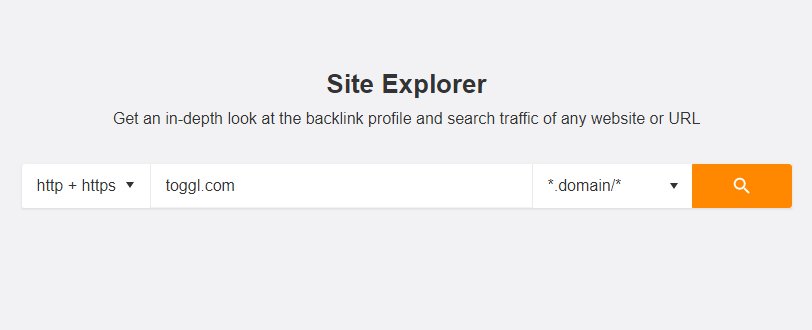
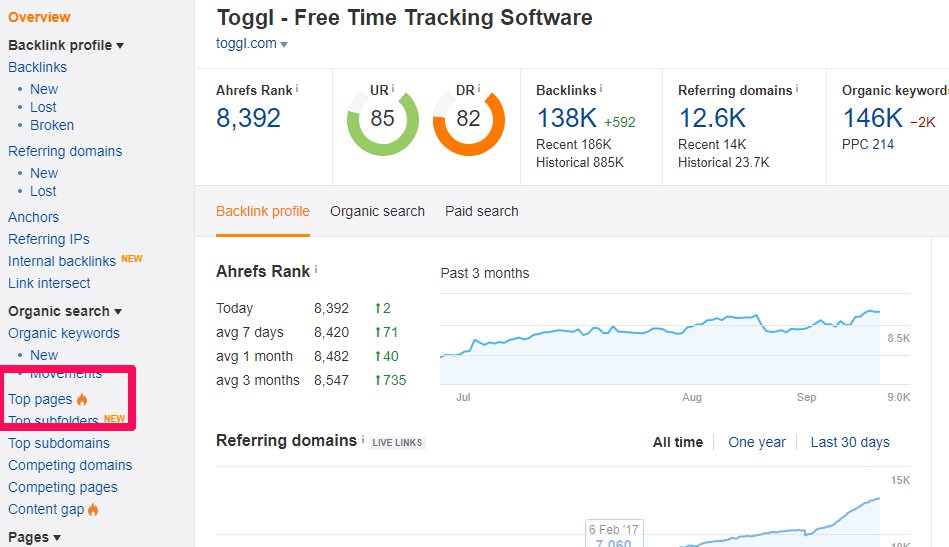
From here, you can check out one of two things. Either top pages or top organic keywords.
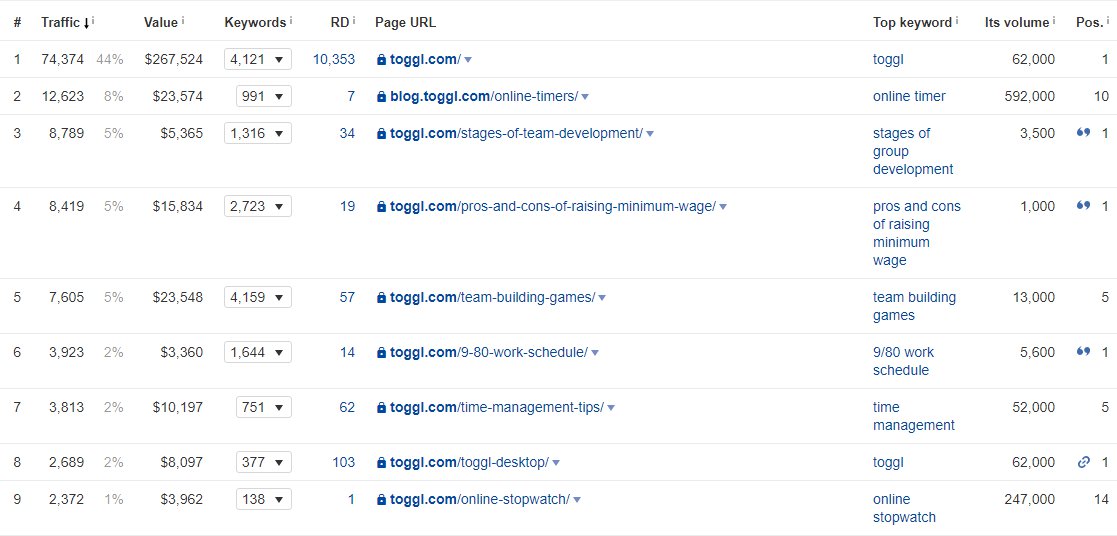
Typically, I like to check out the top pages. Google is smart enough these days that it knows what you’re trying to say with a page. While keywords are still extremely important, I would prefer to see what pages are ranking… not just keywords.
When I click on the top pages of my competitor’s, I’m given a list of their highest traffic pages in descending order.
Part 3: Content Creation Tips
Good keyword research gets you in the game. Good content keeps you there. Here is how to create content that ranks, converts, and gets recommended by AI.
TIP 7: Use One of the Five Content Archetypes
Not all content is created equal when it comes to driving trials and MRR. Over a decade of doing this inside SaaS companies and with clients, I have found that five types of content consistently outperform everything else. I call them the five content archetypes.
These started out as SEO plays. But as AI systems like ChatGPT and especially AI Overviews (in Google) became more prevalent, these archetypes have become even more powerful
They attract and convert organic traffic AND LLMs read them to get your software recommended.
1. Alternative Posts
Your prospect is frustrated with the 800-pound gorilla in your category. They search '[Competitor] alternatives.' Your job is to rank for that search and present your product as the obvious next step.
These posts convert exceptionally well because the reader is already in evaluation mode. They are not browsing. They are buying.
Headline formula: [Number] [Competitor] Alternatives + [Optional Benefit]
2. X vs Y Pages
Buyers are looking to compare your product to your competitors to make the most informed decision possible
That's where the X vs Y page comes into play. These pages get a lot of high buyer intent traffic and AI systems tend to use these pages when recommending a short list of products to your prospects.
3. Best Category Posts
'Best [category] software' is one of the highest-intent search formats in SaaS. The searcher knows they need a tool. They are collecting a shortlist. Being on that list matters enormously, both in Google and in AI recommendations.
These posts are also one of the primary sources AI systems reference when forming recommendations. If you are not appearing in best-of lists, both on your own site and on high-authority third-party sites, you are invisible to a growing portion of your buyers.
4. Template Posts
Find a task your product automates. Create a post that gives away a free template for doing it manually, then show why your product does it better.
At Time Doctor, we created a post called 'Timesheet Templates.' We gave away free Google Sheet, PDF, and Excel templates. The post ranked for a keyword with 7,700 monthly searches. Then, at the bottom of each template, we made the case for why manually managing timesheets was painful and Time Doctor automated the whole thing.
That post was responsible for adding 309 businesses to our customer base, with 20 to 25 new customers coming in every month.
Give away the manual solution for free. Make it genuinely good. Then show why your product eliminates the need to do it manually. The reader feels they got something valuable before you ever pitch them.
These posts target the task your buyer is trying to accomplish, not the tool they will use to do it. 'How to track employee hours,' 'how to manage a remote team,' 'how to reduce churn' are all jobs to be done.
The key to making these convert is to make your product a natural, inevitable part of the solution. You want the reader to finish the post feeling like doing the job properly without your tool would be unnecessarily hard.
TIP 8: Write with Your Own Data, POV, and Insider Intelligence
The fastest way to get outranked is to write what everyone else is writing. Generic content gets commoditized quickly, especially as AI-generated content floods every topic.
What cannot be commoditized is your company's own data, your first-hand experience, and the insider intelligence you have accumulated from working in this space.
At Time Doctor, our best-performing content was not the posts with the most keywords. It was the posts backed by real numbers from inside our product. We knew how many customers we had added through a specific page. We knew exactly what the CPC equivalent of our organic traffic was. We knew which features were driving renewals. That data made our content credible in a way no agency-written post could replicate.
Before writing any post, ask: what do we know about this topic that nobody outside our company knows? What data do we have? What have we seen? What opinion have we formed from doing this work every day?
That is what goes in the post. The generic stuff can come from anywhere. The first-hand intelligence can only come from you.
AI systems are increasingly good at identifying original, authoritative sources vs. content that synthesizes existing content. Your proprietary data and first-hand experience are signals that AI systems weight heavily when deciding what to recommend.
Tip 9: Tell Stories
When it comes to ranking your content, getting traffic, shares, and all that good stuff, sharing statistics is the way to go.
However, if you want to win the minds of your readers and convert them into customers, then make sure you tell stories.
And lots of them.
In a survey done by the guardian, 63% of the people recalled a story from a presentation, but only 5% recalled a statistic. (The word you’re looking for is irony! haha!)
In a somewhat embarrassingly large number of my posts, I tell a story about how I first sucked at this whole content marketing thing and then through trial and error got good at it.
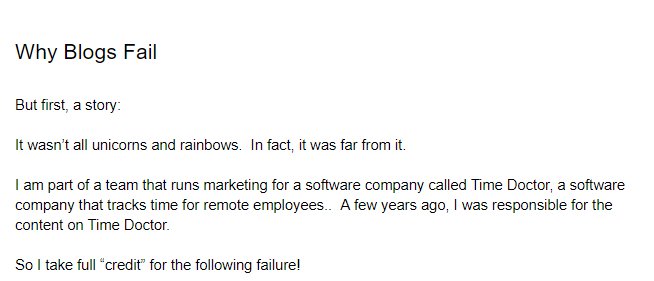
I use the story on several posts, in my emails, on my guides, etc.
Why? Because I know it resonates with so many of my readers.
They can relate to it.
Tip 10: Content Chunking
I don’t know if you’ve noticed, or maybe you have, but my paragraphs are never more than 3 sentences.
Many of my “paragraphs” are just one sentence.
See what I mean?
That’s because big blocks of text are a total turn off for people who are just browsing.
Big blocks of text feel like work.
Who feels like reading that?
When you’re creating a blog post, you must write for the skimmer.
Most people aren’t going to read your post when they first land on your site. They’re going to skim it to see if it’s interesting before investing time into it.
Then, they will read it in full (maybe).
Large blocks of text are not nearly as skimmer friendly as short paragraphs. For instance, who wants to actually read this text?

And here’s why this matters beyond the reader experience.
AI systems don’t read your article the way a human does. They pull specific passages that directly answer a query.
When your content is broken into discrete, well-labeled sections with short focused paragraphs, you are pre-packaging your content for AI extraction. The AI can lift a specific chunk and present it as a clean answer without needing to paraphrase or summarize.
This is also why FAQ sections are so valuable for AEO. Each question and answer is a discrete unit that AI can match directly to a user query.
The practical rule: every major section of your content should be able to answer a specific question on its own.
Write for the skimmer first. You will find that skimmer-friendly content is also AI-friendly content.
Tip 11: Collaborate on Content
One of the best ways to build an audience is to leverage someone else’s.
And one of the best way to leverage someone else’s audience is to feature them in a blog post.
That’s exactly what I did for a blog post about Evergreen Funnels.
At the time of this post, my blog is still relatively new. I’m scratching and clawing for every bit of traffic I could get.
My friend Amy on the other hand as an established audience and an amazing evergreen funnel.
So, I wrote a post about her funnel.
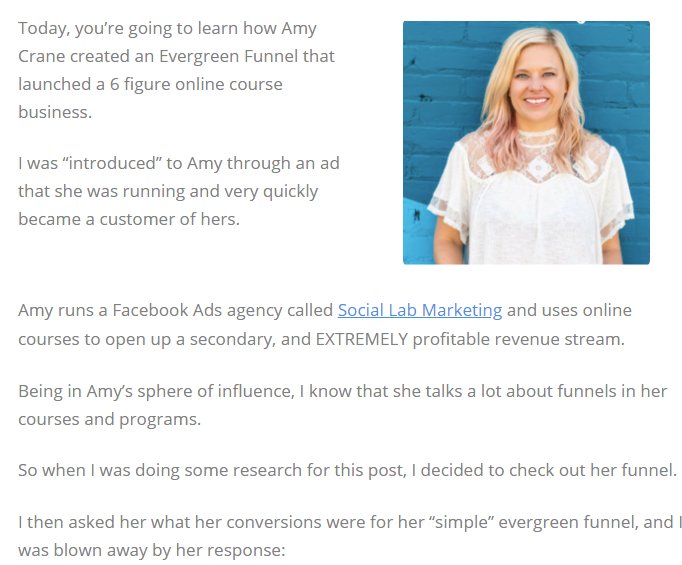
And here’s the cool part:
First, she messaged her Facebook groups
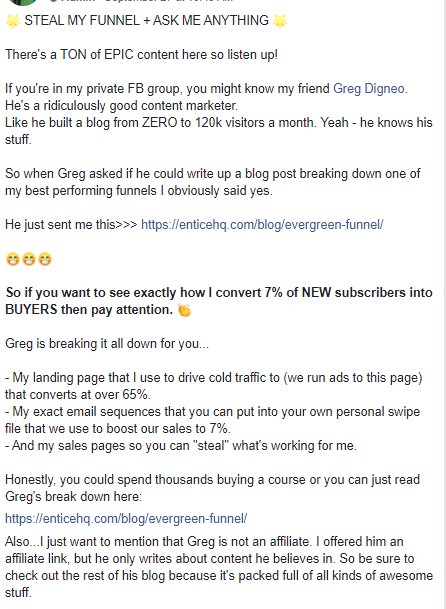
And then sent a message to her email list
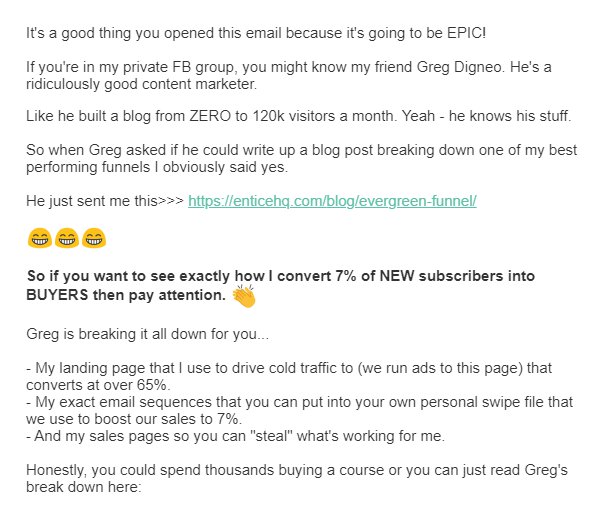
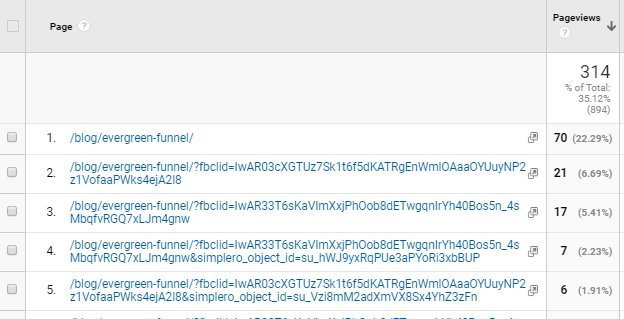
All of that resulted in 314 visitors to my new site.
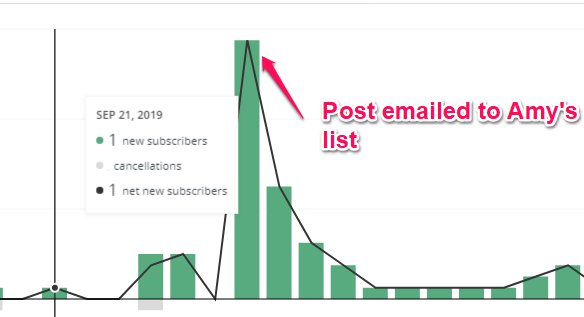
And allowed me to have my two highest email subscriber days.
Part 4: On Page Optimization Tips
Now that you have a great article, it’s time for some on page optimization.
When it comes to on-page optimization, I don’t do tons of it. I simply make sure that I have the basics covered.
Once I’ve done that, I’m fairly confident that my post will rank… eventually.
Tip 12: Include the Keyword in Your Title
The very first thing that we make sure to do include is the keyword in the title.
I know this sounds kind of obvious, but I’m always surprised when I read a post and there isn’t a relevant keyword in the headline.
Here’s a few examples (keyword in parenthesis):
Tip 13: Add Images to Your Post
When it comes to getting traffic to your blog, images are a must.
Blogs with images get 94% more views than blogs that don’t have images. (source)
But please! For the love of all that is good in this world. Do not use stock photos. Nothing screams "This post was created by some cheap writer" like a stock photo at the top of a blog post.
Instead, replace stock photos with:
- Real screenshots of your product in action
- Data visualizations built from your own numbers
- Photos from your actual team, events, or customers
- Custom graphics that illustrate a concept specific to your post
- AI-generated images when they are clearly illustrative, not pretending to be real
Every image in your post is an opportunity to reinforce that the content comes from someone with real expertise.
A screenshot of actual Time Doctor data showing 309 new customers from a single post is worth more than any stock photo of a person looking at a laptop.
Also fill out the alt text for every image. It is a small signal but it compounds across a site with hundreds of posts.
Tip 14: Proper URL Structure
Last but not least, having the proper url structure is another simple on page tip that will help your rankings.
Again, it’s one of those things where you go to a site and say: “why not fix this?”
For instance this is URL from Entrepreneur.com:

Entrepreneur is a huge site, and fixing their url structure probably won’t move the needle much, but why not just take advantage of this?
Anyway, here’s a url from Content Guppy.

Basically, the suffix of the url has the keyword and not much else.
Keep your URL’s as short as possible. Remove dates and any extra words.
Part 5: Link Building Tips
Links are still one of the most important ranking signals. But in 2026, link building does more than help you rank. Done right, it also gets your SaaS recommended by AI. Here is how we think about it now.
Tip 15: The ABC Link Exchange
Let's quickly talk about the biggest challenge with building links today.
Back in 2015, you could write an amazing post, send out 100 emails to other blogs, and some people would link to it out of the kindness of their heart.
Those days are gone.
Today, you have to pay for links in some way.
There are three ways to do that.
- You can give the other site cash in exchange for a link.
- You can pay with content. You write them a guest post that includes a link back to your site.
- Or you pay with a link in return. "You give me a link, and I'll give you one back."
That third option is the ABC link exchange.
Here's how it works.
Step 1: Site A links to Site B.
Step 2: Site B links to Site C.
Step 3: Site C links back to Site A.
Nobody is directly linking back to the site that linked to them. The exchange is spread across three sites. Same value, cleaner footprint.
Ideally, you want to find 10 or so sites you can partner with on a regular basis. These partners allow you to place links on their site. You can then use those relationships to entice other publications to give you a link in return.
At Content Guppy, we have relationships with hundreds of partners that we use to run this process for our clients.
Tip 16: Write Listicle Guest Posts
This is the most important link building tip in this article for 2026.
AI systems like ChatGPT and Perplexity pull heavily from listicle-format content when forming recommendations. When someone asks "what is the best business compliance software," the AI is looking at 'best business compliance software' posts across the web to form its answer.
I pulled this report from a tool called Traqer.ai. As you can see, when the topic of "business compliance software" comes up, most of the top cited sources are "listicles" from across the web.
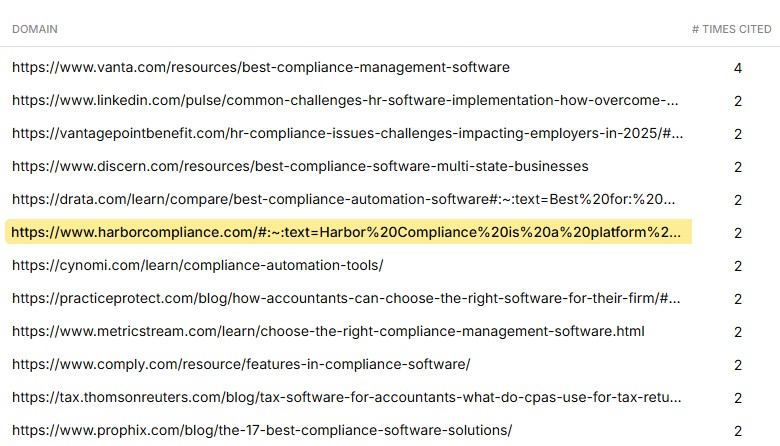
If your SaaS appears in those lists on high-authority sites, you get recommended. If you do not, you are invisible.
The strategy: pitch and write guest posts in the 'best of' listicle format on publications and blogs your ICP already reads. These are not generic guest posts. They are specifically structured to get your product included in the lists that AI systems reference.
What to look for in target publications:
- High domain rating (DR 60 or above)
- Existing listicle content in your category
- Audience that matches your ICP
- Editorial standards that signal the site is trusted as a source
One well-placed listicle on a high-authority publication does three things at once: it passes link authority to your site, it puts your brand in front of a targeted audience, and it gets your product into the pool of sources AI systems reference when forming recommendations.
Step 1: Find a blog to write your post
By entering the following search terms, you’ll easily be able to find a whole list of blogs to write for.
You can simply enter the terms:
- “Name of niche” and “guest blogger”
- “Name of niche” and “write for us”
- “Name of niche” and “guest writer”
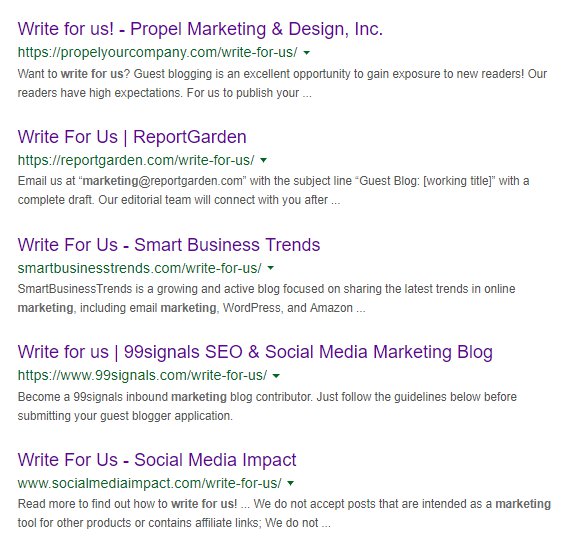
For instance, if I type in “Marketing” and “write for us”, I get pages and pages of blogs looking for guest posts:
Step 2: Analyze the Domain Authority
Writing a guest post takes time. And if you’re going to do it, then make sure that your doing it for a good blog with a high domain authority.
Typically, I won’t write a guest post for any domain under DR65.
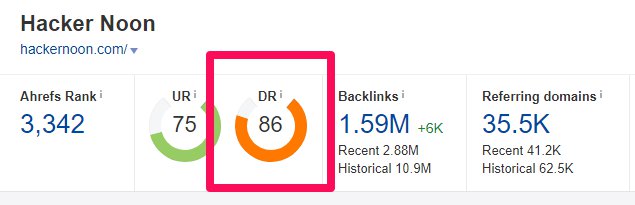
For instance, the DR for Hacker Noon is an 86. Which is a great place to write a guest post and get a high quality link.
Step 2: Pitch the editor
Now that I’ve found a blog to write for, it’s time to pitch the editor.
The first thing I do is look for blog posts that have been successful and come up with an idea around how to spin a new angle.
For instance, If I want to write a guest post called "Top 10 Email Marketing Tools for Ecommerce Companies" here's the email I would write:
Hey First Name
I wrote a guest post called "Top 10 Email Marketing Tools for Ecommerce".
It gets 80 searches per month and has a keyword difficulty of 0.
Would you be interested in publishing this?
Thanks,
Greg
Honestly, the outreach doesn't even matter.
Here's the dirty little secret. If the site let's you publish it, you're going to have to pay for the post, in cash.
Step 3: Write a killer post
Now it’s time to write a killer guest post. You can hire someone to write the post for you and give them your competitor library so they can make sure that your POV is locked into the post.
These posts are great to help you build authority AND they are among the most heavily referenced posts in LLM recommendations.
Ranking in Google and being recommended by AI are increasingly separate outcomes. A brand new SaaS with strong listicle placements on trusted sites can get AI recommendations before it ranks for a single keyword. The listicle is not just a link building tactic. It is an AEO strategy.
TIP 17: Podcast Interviews for Brand Building and AI Visibility
Podcast appearances are the most underestimated link building and AEO strategy available to SaaS companies right now.
Here is why they matter beyond the obvious audience reach:
- Every podcast episode typically includes show notes with a link back to your site, often on a high-authority domain
- Podcast transcripts give AI systems a rich, natural-language source to train on. When you explain what your company does, who it helps, and how it works in a 45-minute conversation, that becomes a high-quality input for how AI systems understand and describe your product
- Branded search volume increases when people hear your name in audio. More branded searches signal to Google that your brand is worth ranking
The combination of a backlink, AI training data, and branded search signals makes a single podcast appearance worth more than most link building tactics that cost significantly more time and money.
Target podcasts where your ICP is the audience. A time tracking software company should be on podcasts about remote work, operations, and HR, not general marketing podcasts. The more specific the audience match, the more qualified the listeners who follow up.
Use a tool like Listen Notes to find podcasts in your niche. Look for shows with consistent publishing schedules and engaged audiences. A show with 2,000 highly targeted listeners is worth more than a show with 50,000 general business listeners.
When you sit down for a 45-minute podcast interview, you are not just recording audio. You are creating a transcript that describes your brand, your product, your customers, and your use cases in natural conversational language. That is exactly the kind of content AI systems are built to understand. A keyword-stuffed blog post tells AI what you do. A podcast transcript shows AI how you think, who you help, and why customers choose you. That context is what gets you recommended, not just cited. No other link building tactic creates that kind of AI training signal as a byproduct.
Part 6: Bonus - Build Your Brand
I saved perhaps the most important tip for last.
But it’s critical to your SEO success.
Let me show you what I mean.
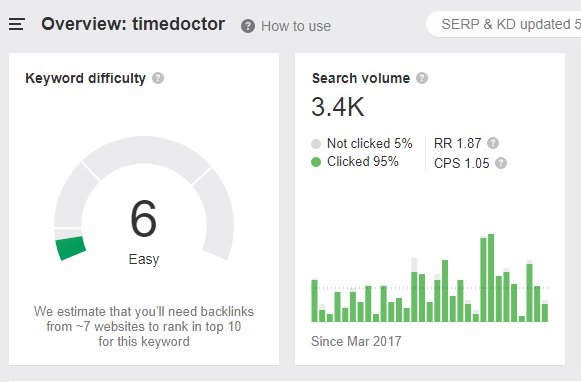
According to Ahrefs, our name “timedoctor” get searched on 3400 times.
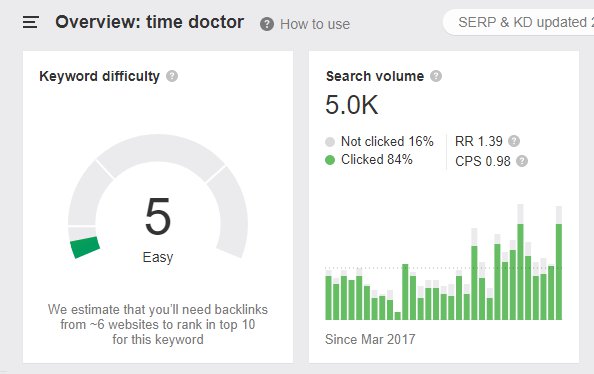
And another 5,000 times for the keyword “time doctor”
Congrats! You Made it!
This post is an absolute beast! So if you’ve made it to the bottom, congratulations.
My advice to you is this: Take a few of these tips and start implementing them immediately.
Use some of the keyword research tips to find more seo friendly content ideas.
Or use the optimization tips and the link building tips to start promoting your existing content and get more traffic.
And if you have any tips that I’ve left out, leave a comment below.
We do this for B2B SaaS companies every day.
Book a free strategy call. We will look at your category, identify high-leverage opportunities, and show you what a content program built around your revenue goals would look like.
Book Your Free Strategy Call