
The Starting Point
Kickbox is an email list cleaning and scrubbing solution. When they came to us, they were bringing in around 175 new customers per month - a solid baseline, but they knew there was more on the table.
Their SEO had two specific problems holding them back.
First challenge: They were creating a ton of content, but they didn't have the traffic to show for it.
Second challenge: The traffic they were getting wasn't converting.
After working with us, we helped them create a single long post that was not only getting them traffic, but was growing revenue by $2,500 per month on its own. Across the full program, new customer acquisition climbed from 175 to 250 new customers per month - a 43% increase.
On one of our best-converting pages, 2.2% of visitors become customers. The page has a fee-to-trial of 4 to 16 per month on average. Strong start.
So let's break down how this happened.
Step 1: A Content Audit
When we first looked at their content overall, we noticed a trend: the content that they wanted to rank for wasn't matching search intent.
Here's what I mean. If you want to rank for something like "best HR software," you would go to a tool like Ahrefs or Google and see what is coming up on the SERPs. When you Google "Best HR Software," Google will basically show you a list of lists - top 10 or software "listicles."
Ranking a service page or landing page for a keyword where the search intent is clearly for list posts. Google doesn't want to rank a product page where listicles dominate the top 10.
Creating a "Best Category Post" - a listicle that bigs up your tool within it, then ranking it with high-quality backlinks. Match the intent, then compete for position.
So ranking a service page or a landing page when the search intent is for list posts will be REALLY hard. Instead, your best bet is to create a list post, brag about your tool within the post, and then rank it with high quality back links. This was the reason why the content Kickbox was creating wasn't ranking. Much of their content didn't align with search intent.
Step 2: A Business Audit
Now that we understood why the content wasn't ranking, we wanted to do a business audit. What keywords were actually going to move the needle for Kickbox?
Remember, they're a software that does list cleaning and scrubbing. A list of SEO's will try to look at the easiest possible keywords.
For instance, the keyword "Undelivered Emails" has a zero keyword difficulty. It's super easy to rank. You can probably create a piece of crappy content, get a few easy links, and get some traffic.

The problem is, when you Google "Undelivered Emails," it's mostly a bunch of sites teaching consumers how to get their emails delivered. The keyword is essentially useless - it attracts the wrong audience with zero commercial intent.
Going back to useful keywords, we realized that ranking for a keyword like "Best List Cleaning Services" or "Best List Scrubbing Services" would be VERY useful to increasing Kickbox's MRR.
A low-difficulty keyword that attracts the wrong buyers is worthless. A harder keyword that attracts people about to make a purchase is priceless. We always audit for buyer intent first, keyword difficulty second.
Step 3: Creating the Content
After doing some research, we realized that "Best List Cleaning Service" and "Best List Scrubbing Services" would be targeting the same post. There was a lot of overlap in the serps for these two keywords - one post could rank for both.
So we decided we were going to use one of Content Guppy's content archetypes and create a "Best Category Post." Basically, a huge list of list cleaning and scrubbing services.
Top 21 Email List Cleaning and Scrubbing Services
And at the very top of the post, we're going to talk all about Kickbox. When someone lands on this listicle, Kickbox is the first tool they see - featured prominently with a full write-up, before they encounter any of the alternatives.

I saw a lot of companies who write these types of list posts and don't put their tool at the top. It sounds nice and humble, but the further down the page your SaaS, the fewer readers will see it. So put it at the top for max impact.
Step 4: Build Links
Now that we had an amazing, in-depth post, it was time to build some powerful links.
We have a very specific link building criteria:
- DR 60+ - only high-authority domains
- Minimum of 1,000 organic visitors per month
- Only links on other SaaS sites or Service businesses
We find these links to be the most powerful types of links that we can acquire. A handful of the right links - relevant, high-authority, on sites your buyers actually read - does more than dozens of links from irrelevant directories.
Why fewer, better links beat more, weaker ones: Every link we build passes authority to the post and reinforces to Google that this content belongs at the top of the results. Three DR 70 links from SaaS-specific domains will outperform thirty links from generic content farms. Quality compounds. Noise doesn't.
Step 5: Rank and Convert
At the time of writing, the post ranks in the top 3 for several keywords:
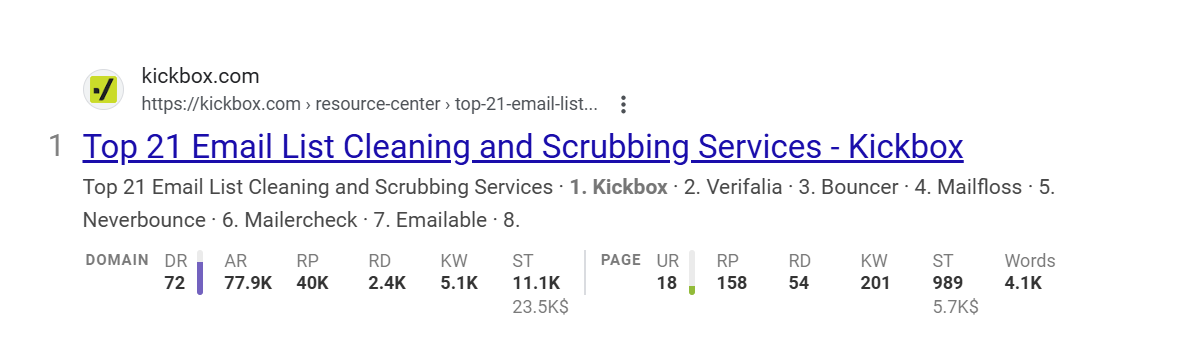
And as you can see, according to Ahrefs, the page gets just under 1,000 visitors per month. That's probably on the low end as well - organic traffic estimates are consistently conservative.
As you can see from the testimonial above, the page is getting about 2.2% of visitors to become trials. And at an average monthly value of $115 (this isn't recurring revenue), the page is getting about $2,500 in new revenue every single month.
The Result: 43% More New Customers
Across the full engagement, Kickbox went from 175 new customers per month to 250 - a 43% increase. One post alone was responsible for $2,500 in new recurring revenue every month, driven by a 2.2% visitor-to-trial conversion rate and leads jumping from 3 to 16 per month.
The playbook that got them there is repeatable. Find a keyword with real buyer intent that the search results show should be a listicle. Create the best, most comprehensive listicle that exists. Feature your product at the top. Build the right links. Rank and convert.
Most companies skip one of those steps - usually the content audit or the buyer-intent research - and wonder why the traffic doesn't convert. Do all five and the numbers follow.
The same playbook we ran for Kickbox is what we bring to every client at Content Guppy today. The tactics evolve, but the question never changes: is revenue going up?