In 2015, I joined a bootstrapped time tracking SaaS called Time Doctor as their second marketing hire.
We had no VC money. At the time, we didn’t even have a marketing budget. So spending money on paid ads was completely out of the question.
But every week, the KPI for our 3 person marketing team was: How many trials did we generate?
We stumbled into SEO by accident. Someone suggested a post called “Toggl Alternatives.”
We didn’t think anything of it. But we published it and to our surprise, got some traffic a few weeks later.
A few weeks after that, we got our first organic trial.
From then on, we doubled down on SEO and content marketing.
By the time I left in 2021, we had grown Time Doctor from $700K MRR to over $10MM ARR.
In 2015, a SaaS Content Marketing strategy was basically another code word for SEO.
Almost the entire content marketing budget went to seo content and link building.
But in 2026, that can no longer work. You need to have a much more comprehensive content marketing strategy if you want to increase MRR.
AI Overviews, ChatGPT, and Perplexity are changing where buyers start their search.
And the amount of features that Google has on the first page (AIO, YouTube videos, What People Want, etc), has dramatically altered the SERPs.
The “10 blue links” no longer exist.
Most SaaS content marketing advice teaches you how to fulfill demand - find keywords, write content, build links, and rank. That’s half the job.
The other half is creating demand that didn’t exist before, and making sure AI recommends you
This post covers both.
Chapter 1: What SaaS Content Marketing Actually Is (and Isn’t)
Let’s start with what content marketing is not.
We don’t see content marketing as purely a brand awareness play. Sure it can do that, but that’s not the purpose. Building a brand is a means to an end.
It’s not a long game you run while you wait for venture capital to fund paid acquisition.
It’s not something you do to get your domain authority up.
Content marketing is a revenue acquisition channel.
The output you’re optimizing for is MRR.
That distinction matters because it changes everything: which keywords you target, what you write, how you measure success, and when you know it’s working.
The companies I’ve seen waste the most money on content are the ones chasing traffic. They publish glossary pages with high traffic and low competition.
They publish “What Is” posts that no one in their target ICP is actually searching for.
And they tend to celebrate traffic. Not actual revenue.
The companies I’ve seen grow on the back of content, including Time Doctor, Kickbox, and several others are ruthlessly focused on one question: is this piece going to bring in buyers?
Here’s the other thing that’s changed.
In 2015, you were optimizing for one place: Google.
In 2026, you’re optimizing for two. Google still matters enormously. But 65% of CFOs now use AI to find new software vendors. For CMOs, that number is 84%.
Which means ranking on page one is no longer enough on its own.
If your content doesn’t get your brand recommended when a buyer asks ChatGPT or Perplexity or AIO for a shortlist of tools in your category, you’re invisible to a massive and growing share of your potential buyers.
The goal of SaaS content marketing in 2026 is to drive revenue.
To do that, you have to get your content to rank AND be on the shortlist that AI recommends. Those are two different things and they require two different approaches.
SaaS content marketing is a revenue acquisition channel. The output you're optimizing for is MRR.
Chapter 2: The Two Jobs of SaaS Content Marketing
Most posts about content marketing talk about “the funnel.” Top, middle, bottom. Awareness, consideration, decision.
That’s a fine framework. But it’s not how I think about it.
I think about content marketing as having two distinct jobs.
Job 1 is demand fulfillment. This is creating content for searches that already exist. Buyers are actively looking for solutions. Your job is to be the best result for that query.
Someone types “Toggl alternatives” into Google.
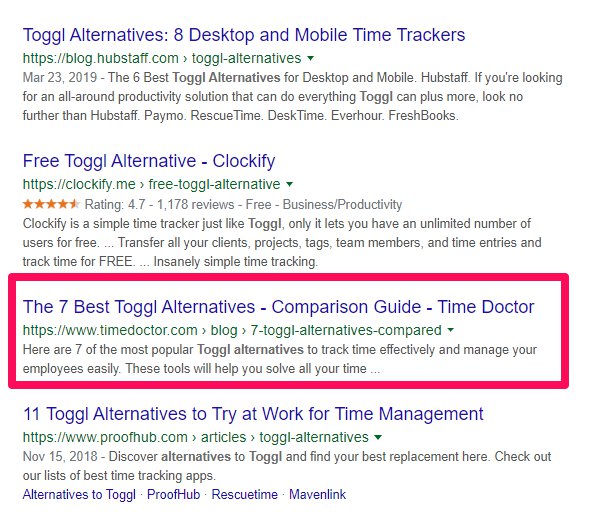
Getting your content to show up when a prospect enters a keyword is demand fulfillment.
They’re already looking for a solution and are ready to buy. They already have a problem. They’re already evaluating options. Your job is to show up and make a compelling case.
This is where most SaaS content programs start… and stop.
Job 2 is demand creation. This is getting your brand in front of buyers before they ever run that search.
- Podcasts.
- YouTube channels.
- Guest posts on publications your ICP already reads.
- Listicles on sites your buyers trust.
This is where most companies have a massive gap.
At Time Doctor, we built the entire first chapter of our growth on demand fulfillment. Alternative posts, comparison pages, category roundups. That content drove the trials that took us from $1M to $10M ARR.
But here’s what I’d do differently if we were running that program today.
I would be building my bottom of funnel content. And then spending the rest of my budget building the company’s brand and creating demand.
SaaS content marketing has two jobs: Demand Fulfillment and Demand Creation.
Chapter 3: Setting Your Content Up for Success
Successful SaaS content starts before a single word gets written.
We our 11 years of doing SEO for SaaS companies, we have found that the way to get content to be seen and convert is to do extensive research.
Not just keyword research. But the type of qualitative research that gives you deep insights into your company, your product and your customers.
Here’s the research process I run before touching any keyword tool.
Step 1: Talk to your sales team.
They hear objections, comparisons, and buying triggers every single day.
They know exactly why prospects choose you over a competitor and why they don’t.
Before building your content plan, spend an hour with whoever is closest to sales.
Ask:
- Why do customers switch to us?
- What objections come up before someone signs?
- Which competitors do we hear about most?
The answers tell you exactly what needs to go into your comparison pages, your alternative pages, and your service pages.
Step 2: Talk to your customers.
Sales teams are really good at spotting patterns and understanding why customers choose your SaaS.
But we like to go one step further and talk to potential customers. This will allow us to determine what they like most about your product.
For instance:
- What feature are you using most in your day to day work? And how does that feature help you?
- What are the most important integrations?
- When do you use the product the most? What is the thing you need to get done?
Step 3: Interview your subject matter experts.
If you're not a subject matter expert yourself, you need to get in front of the people in your company who are, and do it regularly.
Every SaaS company has someone who knows the product inside and out.
- A founder who built it.
- An engineer who can explain how it works.
- A customer success manager who has seen every edge case.
- A product manager who knows exactly what problem each feature was designed to solve.
Your content writers, whether in-house or agency, cannot replicate that knowledge through research alone.
They can read your docs, study your competitors, and produce something that looks thorough.
But it won't have the specific insight, the real example, the counterintuitive take that only comes from someone who lives inside the problem every day.
Make SME interviews a standing part of your content process. Not a one-time onboarding call. A regular cadence. Before every new content push, get 30 minutes with someone inside your company who knows something your writer doesn't.
That's what separates content that gets recommended by AI from content that just fills a page.
Step 4: Build a competitor intelligence library.
Sign up for your competitors’ products and use them. Take screenshots of various dashboards and get to know how they approach the problem that your customers need to solve.
Check G2, Capterra, and Reddit and read the customer reviews. You’ll start to see some patterns about the strengths and weaknesses of each tool.
Check their websites for pricing, specific features, etc.
And keep this all in a competitor intelligence library. It’ll be your guide post for creating all of your content.
SaaS content marketing begins long before you start writing content. The first thing you want to do is interview the most important stakeholders in your company: your sales team, your customers, and subject matter experts.
Chapter 4: SaaS Content Archetypes
Not all content is created equal.
We’ve tested all types of content. We’ve created viral content. We’ve created thought leadership content. But I’ve found 5 content archetypes that consistently out perform everything else.
The ironic thing is, these started out as smart SEO plays. However, as AI systems became more prevalent, these archetypes have become even more powerful.
Here’s a breakdown of each one.
A quick note about keyword research. I created a short video after every archetype showing how we do keyword research for that particular type of content.
Alternative Post
The Alternative Post is one of my favorite posts to write.
And it's one of my favorites for 3 reasons:
1. It's usually not that hard to rank the post in Google
2. It brings in the most qualified traffic you could possibly ask for. Every alternatives post we wrote, we would add two paying users per month.
3. You use the strength of your competition against them..
Here's how it works.
Let’s say you’re competing against an 800 pound gorilla.
Instead of worrying about them, use them to your advantage. One of my favorite seo content hacks is to write an article called “10 large competitor alternatives”.
Back in the day at Time Doctor, our largest competitor, the 800 pound funded gorilla is a company called Toggl. So we leveraged their brand and wrote an article called 7 Best Time Doctor Alternatives.
And then we put our app, Time Doctor, first on the list.
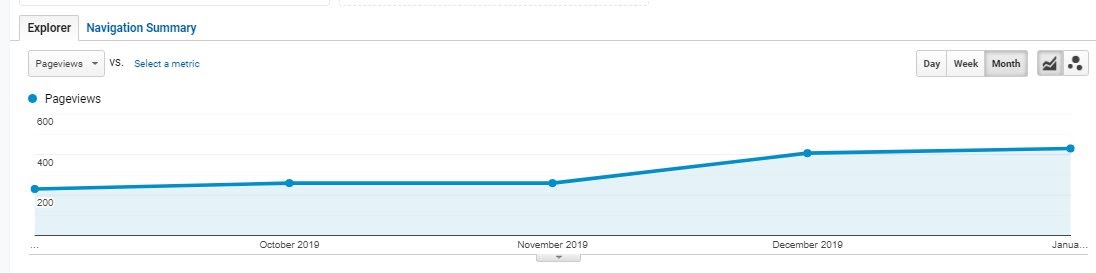
And as you can see, this post, with “low” volume gets between 200-400 visitors a month. And each of those visitors sees us as the first solution on the list!
(We must have moved up in rankings sometime in late November or early December.)
So imagine having 200-400 visitors a month looking for an alternative to your largest competitor coming to your site every single month.
This is why I love Alternative Posts.
Here's a video breakdown for another alternatives post that I wrote so you can see exactly what I did.
X vs Y Post
The X vs Y post is a comparison post.
There are two ways to get this done.
First, if you have a large brand within your market, then you can compare yourself to your competitors.
For instance, our client Superhuman could write posts like “Superhuman vs Gmail”.
Or if you’re the SEO manager at Stripe, you could write “Stripe vs. PayPal”.
At TimeDoctor, once we grew, we would write posts like “Harvest vs. Time Doctor”.
But what happens if you’re just getting started and you don’t really have a big brand yet. And writing a comparison post with you and a competitor doesn’t have search volume.
Well, you can Trojan Horse your way into the article.
For instance, when I started at Time Doctor, we were on no one’s radar.
So, our comparison would be something like “Harvest vs Toggl”...
These were two heavily funded, renowned competitors back then. (They still are.)
After we wrote the post and compared Toggl to Harvest, we would then introduce Time Doctor.
Say something like “Yeah, Toggl and Harvest are good, but here’s why you should try Time Doctor…”
This way, we’re getting the search traffic for the Harvest vs Toggl keywords AND we’re introducing a buying audience to our product.
Here's a video of a straight "brand 1 vs brand 2" breakdown.
And here's a video of what we call a "Trojan Horse" comparison page.
Best Category Post
A potential prospect is looking for a software in your industry because they have a problem they need solved.
So a business owner looking for accounting software will go to Google and ask "best accounting software".
And a list of lists will come up.
For instance:
You want to create content that provides them with the answer to their question... in this case "What are the best accounting software available?"
Can you see how getting folks to your site with a list of tools that solve their problem can be a good thing?
What is a Best Category Post?
A best category post is a list post that lists the best tools in a particular category.
Think: Best accounting software, best SEO software, best email marketing software.
Pretty simple, but pretty effective.
But here's the key, you can think outside of the box. Chances are, your software belongs in multiple categories.
For instance, at Time Doctor, we were a time tracking tool for remote employees.
So, our categories could be:
- Time Tracking Tools
- Time Management Tools
- HR Tools
- HR Tools for Agencies
- HR Tools for SaaS companies
- Project Management Tools
- If you're an accounting SaaS, you can be:
- Best Accounting Tools
- Best Accounting Tools for Small Business
- Best Accounting Tools for SaaS
- Best payment processing tools (If you have a payment feature)
Think about all the types of customers you serve and all the use cases.
How to execute it for maximum results?
Headline
The headline for this type of post is quite simple. It's going to be:
[Number] [Category] [Benefit]
Number: I wouldn't go anything less than 10 here. A lot of times, I'll use 17 or 21.
Category: Sometimes when you're doing keyword research you might find that Best Accounting Software has more search volume or less competition than Best Accounting Tools.
I like to add the exact match. It's not a big deal as Google is smart enough to know that when you say "tool", you can also mean "software". But every little bit helps.
Benefit: Quickly say why someone needs this category of software for their business..
Here's some examples:
17 Best SEO Tools to Help You Rank Higher without Breaking the Bank
21 Accounting Tools to Help You do Taxes in Less Time
The 10 Email Automation Software to Grow Your Email List
About Your Tool
You're tool is going to be first! Don't be shy here. Most people won't scroll past the third tool. So if your putting yourself fourth or fifth or modesty reasons, you're leaving a lot of money on the table.
Treat this almost like a mini sales page. You can use a button as a call to action which works great or you can just link to your sign up page.
Body of Post
As for the rest of the tools, I follow a simple formula.
I will use an image that I take from the competitor's website.
I'll make a 100-200 word summary of the tool.
I'll summarize key features.
And then I'll summarize pricing.
That's it.
We recently ranked one a client’s best category post. And here’s how it’s doing:
I've created a video on a "Best Category" post that we built here on Content Guppy.
Template Post
One of my favorite keyword research strategies is to find templates to build that are related to your product.
Here’s why I like them.
First, they attract people who need the problem that your company solves.
Second, they’ll give people an idea of how you approach the problem.
And third, they convert REALLy well.
Most people are going to just use your free template. But there will be people who don’t want to manually do things in a Google sheet - so they’ll download your tool so you can do it for them.
Let me show you an example.
We created a post called Timesheet Templates. At the time I'm writing this email, the keyword currently gets 7700 searches per month - meaning there's a huge potential for traffic there.
Then, you create a post whereby you give away the template for free. Our templates were Google sheets, PDFs, and Excel Sheets.
You can see an image below.
Manually managing timesheets is a real pain in the butt. It is much easier to just have a software do it for you.
Most of the people who read this post are going to just download the free template. They may eventually become customers down the road.
But there are going to be enough people who read the post, realize they don't want to be bothered by doing it manually, and sign up for the tool.
How do you do it?
Now, let's talk quickly about how to execute on this type of post.
Title:
We just kept this simple:
[Number] Free [Category] Templates You can Download and Use Today
For instance:
- 4 Free Timesheet Templates You Can Download and Use Today
- 5 Free Inventory Management Templates You Can Download and Use Today
Body:
Here's the key with this type of post. You're going to give it away for free.
Don't even collect email addresses.
Let people download or have access to the template without any gate of any kind.
We found that when you gate something like this, you lose rankings in search.
We'd much rather have the traffic to our site (we can retarget later if we want) and let them use the templates for free, than not have the traffic at all.
Your Tool:
Throughout the post, and especially at the end, you should just let people that using the template manually is a pain in the butt, and that your tool will make their life a hell of a lot easier.
Here's a breakdown of a Template post.
Jobs to be Done Post
A user will "hire" your SaaS to complete a job faster, cheaper, better, than they would be able to if they did it manually.
A Jobs to be Done Post will show someone how to do what it is they're hiring your software to do... then show how your software does it better.
Quick note: chances are, your SaaS has many different use cases for several different types of users.
Start thinking about all the different ways your users use your SaaS and jot them down.
For instance, at Time Doctor, even though our main "thing" was time tracking for remote employees, we had the following use cases:
- Agencies would use the tool to manage projects
- Agency owners would use the tool to pay their freelancers
- Agency owners and SaaS founders would use the tool to estimate how long projects take
- Medical transcription companies would use the tool to see how much to bill clients
- Call center owners would use the tool to see how long each agent was spending on a customer service call
Here’s how to execute this
Now, let's talk quickly about how to execute on this type of post.
Title:
90% of the time, this is going to be a "how to" post.
Some Examples:
How to do Keyword Research
How to reduce churn
How to claim 1099 employees on your tax returns
Body:
Now you're going to go DEEP into the weeds on how to solve the problem using your software.
I love a "step-by-step" approach.
So if you're post is "how to do keyword research", your outline might look like this:
Step 1: How to find an topic to write about Step 2: How to figure out if the topic is worth pursuing Step 3: How to analyze the competition Step 4: How to analyze relevance Step 5: Keyword difficulty vs. Search Volume etc...
This is going to be a tutorial on how to use your product.
And the best part is: Google loves these types of posts.
Because they solve an actual problem, in depth.
Your Tool:
When you're writing this post, you're going to include screenshots, videos, gifs, etc. of your product.
You want people to feel like they CANNOT do the task properly without signing up for your SaaS.
And here's a video of a Jobs to Be Done post.
Why These Content Archetypes Also Get You Recommended by AI
The content formats we just covered, alternative posts, best category posts, X vs Y posts, jobs to be done posts, template posts, aren't just good for Google rankings. They're the exact formats that AI systems pull from when someone asks ChatGPT or Perplexity for a software recommendation.
Think about what happens when a CFO types "what's the best time tracking software for remote teams" into ChatGPT.
The AI doesn't make that up. It pulls from the web. And the sources it trusts most are the same sources Google trusts: comprehensive listicles, well-structured comparison pages, in-depth category roundups written by people who clearly know the space.
In other words, your alternative post isn't just capturing buyers who are actively searching Google. It's training AI on who you are, what category you belong in, and why you're worth recommending.
Your best category post isn't just ranking for "best HR tools for agencies." It's telling every LLM that reads it exactly which buyer your product is built for.
Your jobs to be done post isn't just a how-to guide. It's a signal to AI that your product solves a specific problem for a specific type of customer.
This is why the content archetypes matter more in 2026 than they did five years ago. The bar for ranking has gone up. But the formats that rank are the same formats that get you recommended. You don't have to choose between Google and AI. Build the right content once and it works across both.
The one thing that changes is quality. Generic, synthesized, AI-written content won't get you recommended by anyone. Your own point of view, your customers' language, your sales team's intel: that's what makes the content worth citing.
You don't have to choose between Google and AI. Build the right content once and it works across both.
Chapter 5: On-Page Fundamentals That Still Matter
The way you structure your content determines whether humans want to read it and whether AI can easily use it to synthesize answers.
Those two things are more connected than most people realize.
Your URL tells an LLM what the topic of the page is before it reads a single word. A clean URL like /email-marketing-software is instantly understood. A messy one like /10-best-email-marketing-software-in-2024 creates noise.
Short paragraphs that contain one thought make it easy for AI systems to extract and use your content. When you write in dense blocks of text, you're making the AI work harder to find the answer. It will find a post that makes it easier.
Subheadlines tell both search engines and AI what the next topic in the post is. They're not just for skimmers. They're a signal about the structure and scope of your content.
Get the structure right and you're building content that ranks in Google and gets surfaced in AI answers. Get it wrong and you're invisible in both.
Setting Your URL Structure
So many companies I consult with will have a URL structure like:
www.companyname.com/10-best-email-marketing-software-in-2024
I find this to be a bad way to set the URL for a few reasons:
It doesn't give you the opportunity to edit the post down the line. What if you decide you want or need to add 10 more tools to the list?
NEVER include a date in your URL. Dates change. URLs remain.
Instead, just keep it super simple:
www.companyname.com/keyword
For instance:
www.companyname.com/email-marketing-software
www.companyname.com/ahrefs-alternatives
www.companyname.com/timesheet-templates
That way, if you need to edit the post, the URL will still describe what the post is about.
Content Titles
Your content's title is probably the single most important determinant if your content gets read, or not.
More specifically, we're going to think about post titles as it relates to SEO.
Let's take a look at a post title for a keyword like "Mailchimp Alternatives".
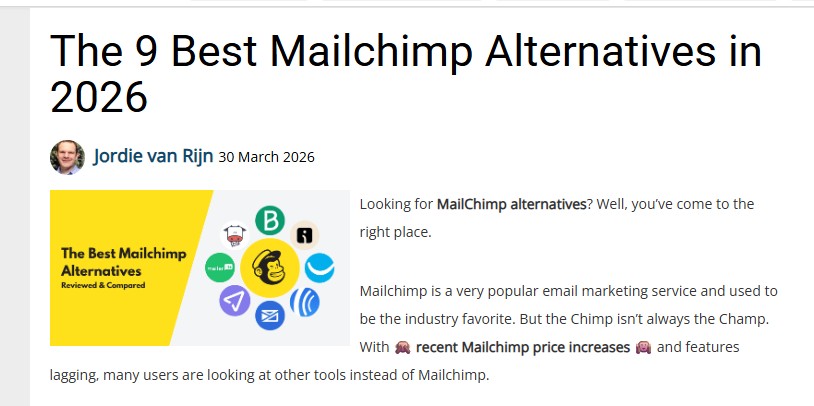
Post headline example
Thing 1
The post title has the keyword in it.
This is very important. When I consult with companies who's content isn't ranking, one of the first things I look at is the post title. Is the keyword in the H1?
Thing 2
The year is in the post.
This means the post is updated and relevant.
Thing 3
This title is direct and to the point.
It's not cute or witty. To be honest, it might even be a bit boring.
Most of my titles are a lot like this. But in 2026 and beyond, I'm going to be experimenting with posts that are a bit more spicy.
10 Best Mailchimp Alternatives to Crush Your Email Marketing Campaigns
10 Mailchimp Alternatives that Aren't Completely Feature Bloated
10 Best Mailchimp Alternatives that You can Actually Afford
But if you're just getting started with SEO for your SaaS, don't worry too much about making it cute. Get the keyword in the H1. Put the year if needed to keep it relevant.
Title Tags
Title tags are the headlines you see when you enter a keyword into Google.
90% of the time, they're taken straight from the content's H1 tag.
Title tags have a VERY significant role when it comes to increasing click through rates.
The higher the clickthrough rate, the higher your post will rank.
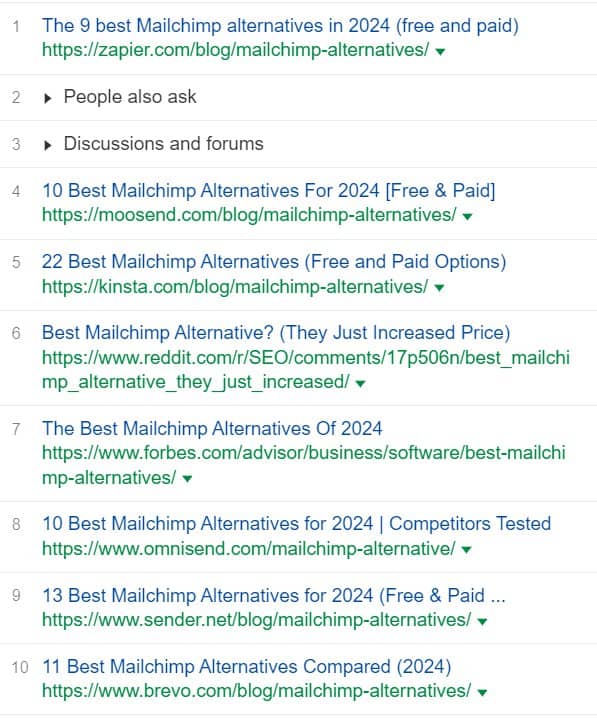
Post title tags example
EVERY SINGLE ONE OF THESE TITLES IS ALMOST THE EXACT SAME!!!
So, let's talk about how to make your title tag a bit more... interesting!
First, you can have a much bigger list. Instead of 10, 11, or even 22 Mailchimp alternatives, you can have 101 Mailchimp alternatives.
The second thing you can do is add personal experience. For instance:
We tried these 10 Mailchimp Alternatives for a Week, and Here's what We Learned
Look at what types of titles are ranking in the top 10 and make yours more interesting.
Subheadlines
I have some bad news for you.
The truth is, you're going to spend all this time or money creating content. And almost no one is actually going to read it.
They're going to skim it.
Which is why you need subheadlines. Otherwise known as H2, H3 tags. (I typically don't go below H4 tags.)
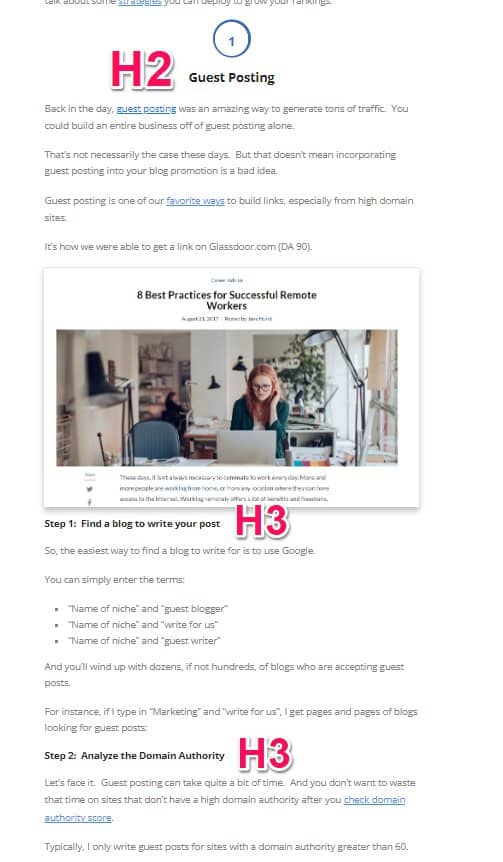
Every time you change topics within a post, you're going to add a new subheadline.
Create SEO Subheadlines
From time to time, I like to create optimized subheadlines. This doesn't always work, nor do I go over the top with it. But maybe once or twice a post, I'll optimize a subheadline to a keyword related to my overall post.
SEO Subheadline Ideas
contentguppy.com/blog/saas-link-building
contentguppy.com/blog/saas-seo-tips/
Line Spacing
I just wanted to quickly talk about spacing.
More specifically, line spacing.
In all of my content, I tend to write short paragraphs.
No more than two or three sentences.
Sometimes, it's just one sentence.
Sometimes, it's just a few words.
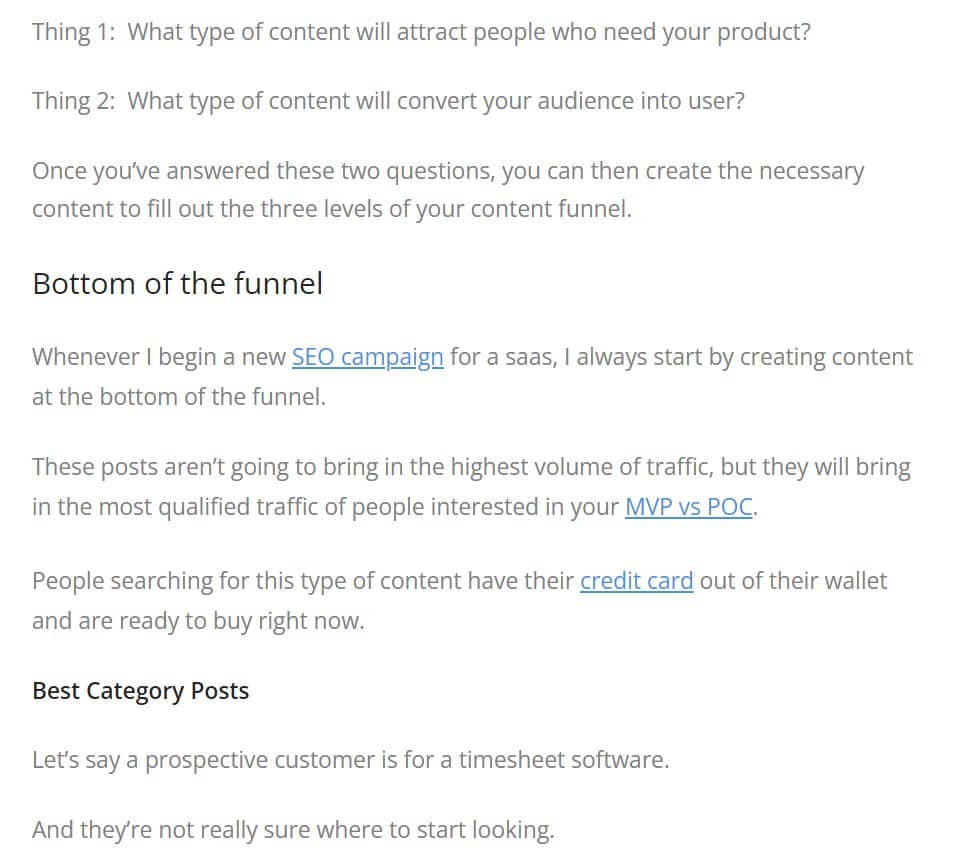
See how spaced out all the text is?
The reason is this:
If you have large blocks of text in your content, your reader will skip it. We've found that creating these spaces INCREASES time on site.
Which increases rankings.
You might not need to be as crazy as me with your spacing.
But avoid text blocks at all costs.
Converting Traffic into Leads
So, you're spending a lot of time and money getting the right traffic over to your site.
You're attracting your ideal buyers with sound keyword research.
You're leveraging content archetypes to help convert traffic into users.
But there's one more thing we could be doing.
And while you may cringe at the thought, they do work.
I'm talking about "Exit Intent Popups".
When someone is about to leave your site, a popup will appear giving them an offer.
At Time Doctor, we leveraged a full screen Exit Intent Popup that we split tested the hell out of.
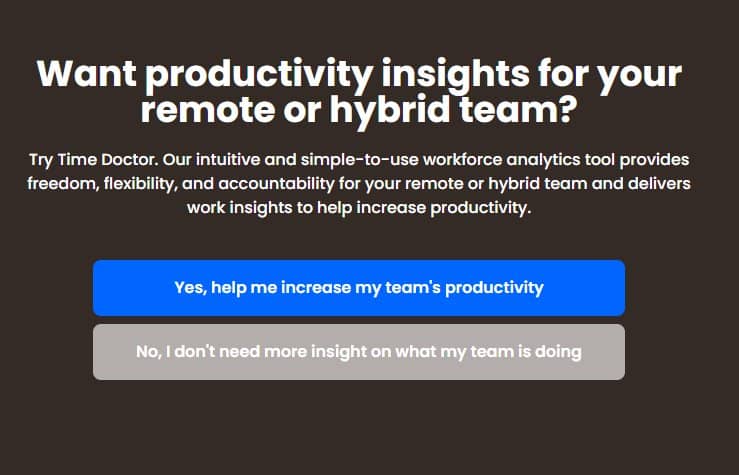
Even at about 10,000 visitors per month, fractions of a percent improvement can lead to a lot of trials.
At that level of traffic, every 0.1% increase in conversion rate adds 10 extra users to our app.
When you get to 100,000 visitors a month, those fractions of a percentage add up to hundreds of new users per month.
(For the record, when I left Time Doctor, our popup was converting at about 2%)
Some Tools to Use:
- Sumo.com
- Mailmunch
- Optin Monster
- Hubspot
Again, I know a lot of people cringe at the thought of a popup, but they could make some huge differences in your MRR. Especially when your traffic is growing rapidly due to SEO.
The way you structure your content determines whether humans want to read it and whether AI can easily use it to synthesize answers. Those two things are more connected than most people realize.
Chapter 6: Getting AI to Recommend Your SaaS
If you structure your content the way we outlined here, then you’ve laid the foundation for getting LLMs to recommend your SaaS.
But we’ve found that 80% of AI recommendations come from off page activities. In other words, where is your SaaS being talked about?
AI cites sources when it’s pulling a fact. AI recommends brands when someone asks “what’s the best tool for X.” Being cited is useful. Being recommended drives trials.
What drives recommendations?
A 2025 Ahrefs study found that branded web mentions were among the highest-correlating factors with appearing in Google’s AI Overviews.
At Content Guppy, we help companies get branded web mentions a few ways:
- Podcast appearances
- Listicle placements
- Guest posts
- Newsletter features (with ungated content)
Here’s what that looks like in practice.
Listicle placements.
We pulled data from Traqer.ai on what types of content get cited most for “business compliance software.”
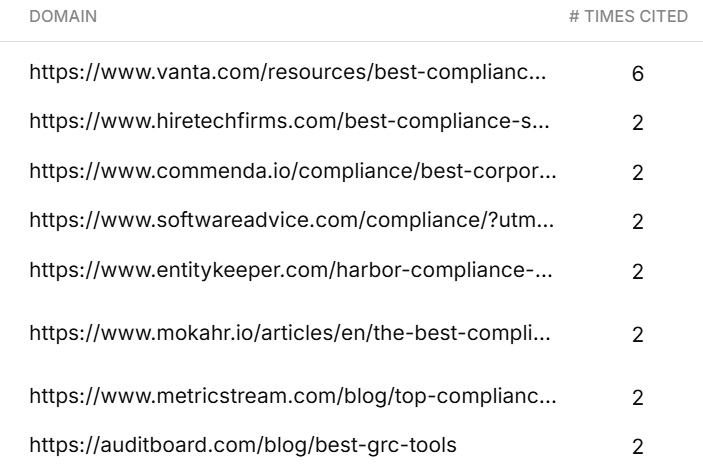
The top cited sources, by a wide margin, were listicles.
As you can see, 6 of the top 8 sources cited were list posts.
When someone asks ChatGPT “what’s the best X software,” it’s not pulling from your homepage.
It’s pulling from “best of” lists across the web.
If your SaaS is on those lists, you increase your chances of getting recommended in LLMs.
Brand Distribution Through Listicle Guest Posting
LLMs pull heavily from listicles when forming recommendations.
When someone asks ChatGPT "what's the best employee engagement platform," the top results it draws from aren't homepages or product pages.
They're listicles.
This makes listicle guest posts one of the most important link building tactics you can invest in right now.
Here's why they compound.
Once a listicle gets cited by an AI platform, it tends to keep getting cited. The brand mentions on that page build entity signals over time. And the backlink to your site passes authority every time the page gets crawled.
One well-placed listicle on a high-authority site can drive AI recommendations for months or years.
How to Execute It
We write the listicle for you. A "10 Best [Category]" post targeting a keyword your buyers are actually searching for. Then we pitch it to publications in your niche.
The keyword should have real search volume. The post should be genuinely useful, not just a vehicle for your brand. And your SaaS should be featured prominently, with a real description of what it does and who it's for.
Listicle Guest Post Outreach Script
Hey [first name],
We wrote a guest post called [Post Title].
The keyword gets [X] searches per month and has a difficulty score of [X] according to Ahrefs.
We would love to publish it on your site.
Thanks!
[Your Name]
That's it. Short, specific, and leads with value for their site, not just yours.
Examples
sprintzeal.com/blog/telecom-expense-management-solutions
outranking.io/blog/streaming-avid-over-zoom-solution/
Podcast appearances.
A single podcast appearance gets distributed across YouTube, Spotify, Apple Podcasts, the host’s blog, and their newsletter.
That’s five or six brand touchpoints from one conversation. You’re giving LLMs rich, natural language content about who you are, what you do and who you help.
So let’s talk about how to get on a podcast:
Building Brand Authority Through Podcast Guesting
Getting on podcasts is one of the highest-leverage link building tactics you can invest in right now.
And most people aren't doing it.
Here's why it works so well.
A single podcast appearance gets distributed across YouTube, Spotify, Apple Podcasts, the host's blog, and their newsletter. That's five or six brand touchpoints from one conversation.
The transcript gets indexed by Google and cited by AI platforms. You're giving LLMs rich, natural-language content about who you are, what you do, and who you help, in a format they're specifically built to understand and surface.
You're borrowing an established audience that already trusts the host. That trust transfers.
And you get a backlink from the show notes. On a real site, with a real audience, in your exact niche.
No other link type does all of those things at once.
How to Find the Right Podcasts
We use Listennotes.com to search for podcasts in our clients' niches. You can filter by category, audience size, and posting frequency.
You're looking for podcasts with a few thousand listeners minimum, that post regularly, and whose audience matches your ICP.
Create a Media Page for Your Spokesperson
Before you pitch a single podcast, create a media page for whoever is going to be the guest. This should include their bio, topics they can speak to, past appearances if any, and a headshot.
Podcast hosts are busy. The easier you make it for them to say yes, the more yeses you get.
Outreach Scripts That Work
Keep it short. Lead with value for their audience, not a pitch for your product.
Hey [Podcast Host Name],
I'd love to introduce you to [Name], [Title] at [Company]. [He/She] helps companies solve [specific problem].
[He/She] has compelling data on [insight that would interest the host's audience], and how companies like [client or example] are [achieving result].
Would [Name] be a good fit for [Podcast Name]? Happy to send over more details.
Best,
[Your Name]
Hi [Podcast Host Name],
Quick question: would your audience be interested in hearing about [topic relevant to their show]?
[Name] from [Company] has helped [type of companies] achieve [result] using [approach]. [His/Her] insights on [specific angle] could be valuable for your listeners.
Let me know if you'd like to explore this!
[Your Name]
Each appearance creates ripple effects across platforms: mentions, backlinks, brand signals, and entity authority.
You'll get your brand in front of thousands of listeners who match your ICP.
And you'll give LLMs training data on who you are and what you do.
AI cites sources when it's pulling a fact. AI recommends brands when someone asks "what's the best tool for X." Being cited is useful. Being recommended drives trials.
Chapter 7: Link Building as Part of Content Marketing
Links are still what get the initial rankings that then earn the organic traffic.
Back in 2019, a link builder had one job: rank content in Google.
Most link building agencies are still only thinking about job one. We think about all three.
What Makes a Good Link
We’ve been ruthlessly specific about the types of sites we get links from. A good link needs to meet three criteria:
- DR 60 or above. We want real domain authority. Some of our links include Qualtrics (DR 91), Glassdoor (DR 91), and Dribbble (DR 93).
- Minimum 1,000 organic visitors per month. Real traffic signals to Google that the link comes from a trusted, active source.
- An actual SaaS or B2B service business. This one rule alone eliminates almost every content farm, PBN, and spammy affiliate site in one shot.
The Kickbox Case Study
About 18 months ago, Kickbox came to us with a problem.
They were creating a lot of content, but they weren’t getting the traffic to show for it.
The issue was search intent. They were trying to rank a service page or landing page for a keyword where Google clearly wanted to serve listicles.
It doesn’t matter how many links you build to a product page when the top 10 results are all list posts. You’re fighting the SERP instead of working with it.
Here’s what we did instead.
We ran a content audit and identified a keyword with real buyer intent:
“Best Email List Cleaning Services.” We created a Best Category Post a comprehensive listicle covering the top 21 email list cleaning and scrubbing services, with Kickbox featured prominently at the top.
Then we built targeted, high-quality links to it.
The results:
The post ranks in the top 3 for “best list cleaning services” and several related keywords.
It gets just under 1,000 organic visitors per month. 2.2% of those visitors become customers. Meaning that single post gets about 22 new customers every single month.
Here’s how to acquire high quality links in 2026.
The ABC Link Exchange
Let's quickly talk about the biggest challenge with building links today.
Back in 2015, you could write an amazing post, send out 100 emails to other blogs, and some people would link to it out of the kindness of their heart.
Those days are gone.
Today, you have to pay for links in some way.
There are three ways to do that.
- You can give the other site cash in exchange for a link.
- You can pay with content. You write them a guest post that includes a link back to your site.
- Or you pay with a link in return. "You give me a link, and I'll give you one back."
That third option is the ABC link exchange.
Here's how it works.
Step 1: Site A links to Site B.
Step 2: Site B links to Site C.
Step 3: Site C links back to Site A.
Nobody is directly linking back to the site that linked to them. The exchange is spread across three sites. Same value, cleaner footprint.
Ideally, you want to find 10 or so sites you can partner with on a regular basis. These partners allow you to place links on their site. You can then use those relationships to entice other publications to give you a link in return.
At Content Guppy, we have relationships with hundreds of partners that we use to run this process for our clients.
Back in 2019, a link builder had one job: rank content in Google. Most link building agencies are still only thinking about job one.
Chapter 8: Measuring What Actually Matters
MRR is the metric we focus on most at Content Guppy.
Metrics like traffic, rankings, and citations are early indicators for whether or not what we’re doing is working. But at the end of the day, revenue pays the bills.
One of the things that drove me to start Content Guppy was watching agencies use traffic and rankings as their primary KPIs.
I’d see clients paying good money for super high top of funnel “What Is” posts that ranked for informational keywords and drove zero revenue.
Think about it. If you’re targeting CMOs of companies doing $50 Million in revenue, do you really think they’re going to Google “what is a cms?”
Of course not, they’re going to Google “what’s the difference between wordpress vs. webflow?”
Or “What tools integrate with webflow?”
Or more specifically: “Does Hubspot integrate with Webflow?”
My only KPI at Time Doctor was the same every month: how many trials did we generate?
That forced every content decision to be a revenue decision.
Here’s how to connect the two.
Connect your organic channel to your trial and demo data. Which posts are sending people to your signup page? Which posts are generating MQLs? Which archetypes are converting, and which are just collecting traffic?
The Kickbox engagement is a good example of measuring the right things.
When we started working with them, we didn’t track rankings as success.
We tracked new customers per month. (went from 175 to 250).
So a number like $2,500 in new MRR per month from a single post was the only number that actually mattered.
For AI visibility specifically: use a tool like Traqer.ai to monitor whether your brand is showing up in LLM responses.
But in all honesty, we haven’t really found a way to correlate recommendations with revenue.
My only KPI at Time Doctor was the same every month: how many trials did we generate? That forced every content decision to be a revenue decision.
Chapter 9: When to Build In-House vs. Hire an Agency
There are a few reasons to hire an agency over building in-house.
You need to ramp up quickly. You don't want to spend months building processes, hiring, and training. With an agency, you're up and running.
You're paying for results, not people to manage. No HR overhead, no ramp time, no underperformers to deal with.
You get a partner who's seen multiple SEO campaigns across multiple industries. We run multiple tests at the same time and are able to compile our own playbook of what works.
SEO and AEO are moving fast. As an agency, we're testing strategies across multiple clients simultaneously. What we learn on one engagement benefits all of them.
You can leverage our existing relationships. Link building, podcast placements, guest posts. Those relationships take years to build. You get them on day one.
Hiring an agency means you're up and running immediately, without the overhead of building a team. You're paying for results, not people to manage. And you get relationships, playbooks, and cross-client learnings that would take years to build on your own.
Conclusion
Back in 2016, when I started content marketing at Time Doctor, the playbook was straight forward.
Do keyword research, outsource content to a cheap writer, build links. And if you did things somewhat correctly, you’d increase revenue.
There was almost no competition. And the bar for content was much, much, much lower.
SaaS content marketing in 2026 has changed dramatically.
Now, you need to
- Do intensive customer research
- Write with proven content archetypes that get ranked and drive recommendations
- Have a strong point of view that you repeat over and over
- Build high quality links
- Build a brand
- Be seen on YouTube channels
- Be heard on Podcasts
- Get recommended by various LLMs
The intensity, the competition, the amount of things you need to do to succeed has amped up the intensity a lot.
And I’m here for it.
SaaS content marketing is no longer short hand for SEO. You can no longer make it some mechanized thing that we do. Keyword research, content, links. It was productized. So boring. And created such crappy content.
Now, content marketing for SaaS requires creativity, skill, thought, and analysis.
It’s harder, but so much more fun.
We do this for B2B SaaS companies every day.
Book a free strategy call. We will look at your category, identify high-leverage opportunities, and show you what a content program built around your revenue goals would look like.
Book Your Free Strategy Call