I've been doing SEO for B2B companies for 11 years.
In that time I have helped generate over $80 million in revenue across bootstrapped and funded companies.
I started as the second marketing hire at a bootstrapped SaaS, where the only metric that mattered was how many trials did we get this month.
That experience shaped how I built Content Guppy and how I evaluate every other SEO agency on this list.
Because here is the truth: most B2B SEO agencies are still running a 2016 playbook. Keyword research, cheap content, some links, hope to rank.
That no longer works in an AI world. Where Google has become more of a recommendation engine and not search engine.
The agencies on this list are prepared for a new era of search.
They have each built something that connects SEO to actual business outcomes. Some are stronger on content. Some are stronger on technical.
I will note the differences so you can find the right fit for where your company is right now.
B2B SEO Agencies Compared
Every agency on this list now says it does AEO. The difference is what they actually do to get you recommended, and whether they build your brand off-page or just on your site.
| Agency | Best for | Starting price | What they do for AEO | Off-page brand building |
|---|---|---|---|---|
| 1. Content Guppy | B2B SaaS that wants to be recommended by AI, not just ranked | On request | Podcast placements, brand mentions, listicles, and interview-driven content. The foundation of how we work, not an add-on. | Podcasts, YouTube, listicle guest posts, brand mentions, newsletter features |
| 2. Grow and Convert | Mid-market SaaS that wants bottom-of-funnel content tied to conversions | From $10,000/mo | Topic-level GEO strategy, backed by their own AI visibility tracker and drafting tool | Link building included. Podcasts and brand campaigns are not a core service. |
| 3. Omniscient Digital | Established, funded B2B software companies | From $10,000/mo | Dedicated GEO service alongside SEO and content | Digital PR and link building |
| 4. Optimist | B2B tech teams that want AI-referred pipeline they can measure | From $2,500/mo | CORE framework runs SEO and AEO as one program. Published revenue results from ChatGPT, Perplexity, and Claude. | Digital PR and link building |
| 5. Directive Consulting | Enterprise and well-funded mid-market tech | Custom, typically $20,000+/mo | GEO built on technical SEO, content intelligence, and digital PR, with heavy R&D behind it | Digital PR, plus paid media and RevOps |
| 6. Skale | Series A and B SaaS that measure organic in MRR | Custom | Entity building, structured data, and AI citation outreach. Also sells AI citations as a standalone service. | Off-page specialist on every client pod |
| 7. MADX Digital | Scale-up SaaS that wants a GEO-led playbook with a guarantee | On request, tiered by stage | Proprietary AI search tracking plus brand mention campaigns across ChatGPT, Perplexity, and AI Overviews | Digital PR, link building, brand mentions |
| 8. Siege Media | Mid-market to enterprise brands that need content at scale | On request | Dedicated GEO practices across eight industries, including SaaS and cybersecurity | Digital PR, linkable research assets, Reddit |
| 9. Virayo | Growth-stage SaaS focused on bottom-of-funnel pipeline | Custom | Tracks how each LLM describes your brand, flags inaccuracies, and optimizes content for retrieval | Listicles, review sites, directories, industry publications |
| 10. Quoleady | Early to growth-stage SaaS, strong in European markets | $1,500 to $2,000/mo | LLM visibility audits, schema markup, llms.txt setup, and PR in AI-trusted publications | Listicle placements, brand mentions, top-tier media PR |
The 10 Best B2B SEO Agencies in 2026
1. Content Guppy
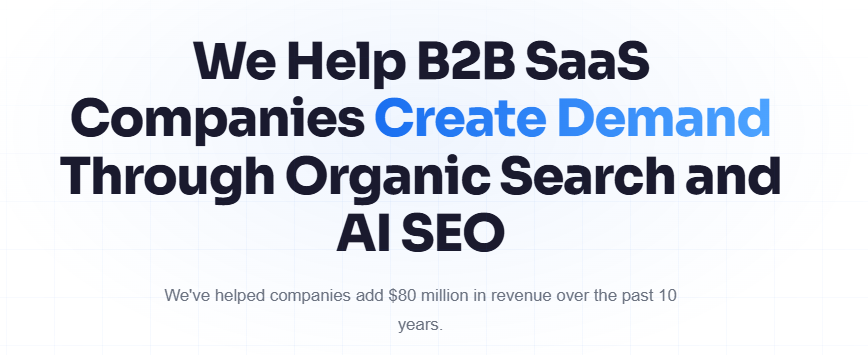
We have spent the past five years building, tweaking, and growing a B2B SEO agency designed to help SaaS and service based companies increase MRR.
Like I mentioned, the way we did SEO back in 2015 will not work in 2026. Here is how we have adjusted our system to address the factors we discussed above.
1. Create content for more sophisticated buyers
Instead of creating a content brief, shipping it off to a writer who has no idea what they are talking about, and publishing, we create content with your point of view.
We do this two ways:
Interviews with SMEs. The first thing we do is interview subject matter experts within your company so we understand your point of view on a particular topic. The goal is to create content that ONLY your company can create. We want to know why your SaaS does what it does, why it exists within the marketplace, and what you want your customers to know about the product.
Interviews with sales team and customers. We also interview your customers and sales team. This is where the real data comes from. Straight from the trenches. A few of the questions we ask:
- Why did your customer hire your SaaS?
- What features are most important?
- What integrations are the most used?
- Why did they switch from what they were doing?
2. Get recommended
We used to simply create content that was regurgitated research. We added nothing new to the ecosystem. And sadly, most agencies still do this today. They throw a brief into AI, or give it to a cheap writer, and call it a day.
But this is not how content gets recommended in an AI search world.
We are not just an SEO agency that bolted on AEO services when it became the thing to do. We rebuilt our entire process from the ground up. From how we create content, through our interview process, to how we promote content.
Before, we used to build links, rank the content, and be done. But now we get you on podcasts and YouTube channels so you can share your POV.
We write guest posts promoting your SaaS. And we get you brand mentions on high-authority sites. This is how you dominate in the SERPs and get your SaaS shortlisted in LLM recommendations.
3. Create demand
SEOs can no longer just fulfill demand. You cannot just rely on people searching Google for your keywords, product, or company.
At Content Guppy, we create demand by getting our clients in front of other people’s audiences and sharing their product and point of view far and wide.
This includes getting interviewed on podcasts and YouTube channels, guest posts on popular blogs, newsletter features, and brand mentions.
4. Revenue is all that matters
How we hold ourselves accountable is by creating content that converts traffic into trials and demos. You will see content on your site and know that it is producing revenue, not just increasing traffic.
Notable clients: Superhuman, Time Doctor, Kickbox, V2Cloud
2. Grow and Convert
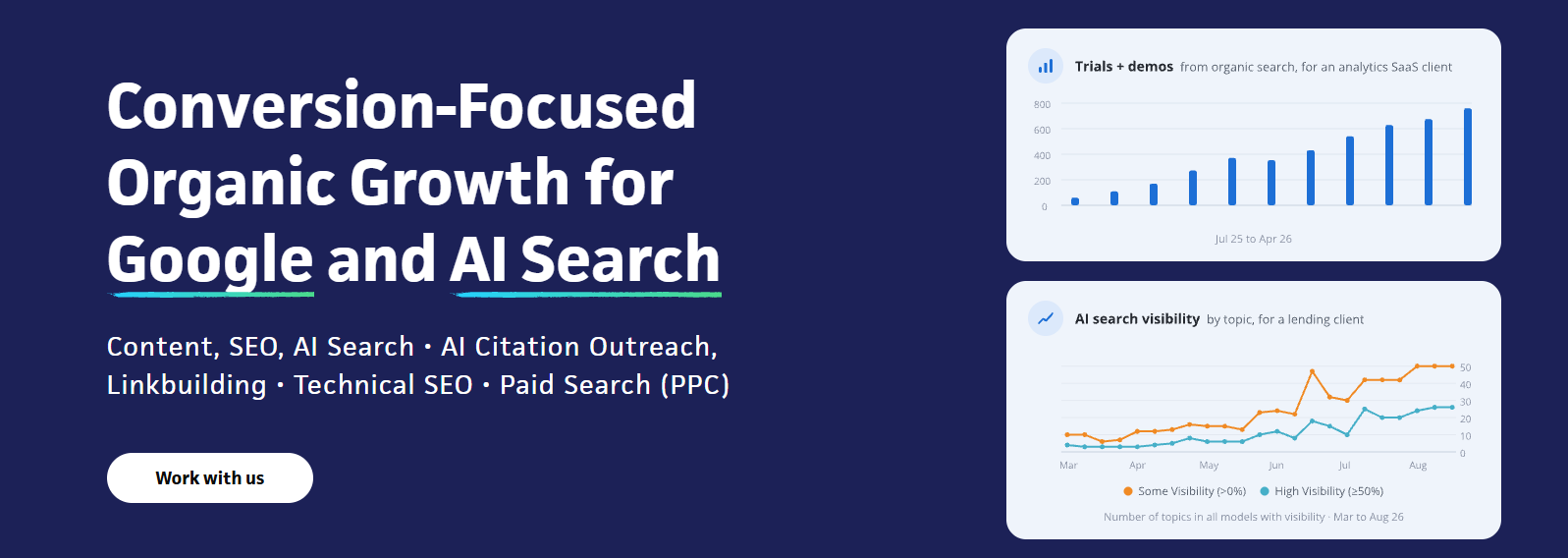
Grow and Convert coined the term Pain Point SEO back in 2018 and have been building their whole methodology around it ever since.
The idea is straightforward: B2B companies should prioritize high buying-intent keywords, the ones buyers search when they are actively evaluating solutions, rather than chasing high-traffic educational content that rarely converts.
Their content research process is done right. They conduct direct interviews with client sales teams, product teams, and customer success teams to surface the actual language buyers use. All content is human-written. And they track conversions at the page level, so clients can see which pieces are driving demos and signups, not just traffic.
What I respect most is that they publish their numbers. One case study walks through Pain Point SEO for an all-in-one SaaS product they've worked with for nearly three years, where the pages they built now drive 150+ demo requests per month. Few agencies show their work at that level of detail.
On AI search, they've built their own tooling. Traqer.ai tracks AI visibility at the topic level, and WaveWriter.ai uses brand and product context to speed up drafting. Their GEO strategy maps the different angles a buyer might prompt an LLM with inside a category, then builds content to cover each one.
If you are comparing Grow and Convert to Content Guppy, the key difference is what happens beyond the content.
Content Guppy runs podcast placements, listicle guest posts, and brand mention campaigns to build the off-page signals that determine whether AI recommends you.
Grow and Convert is primarily a content and link building agency. Both approaches are valid. The right choice depends on whether AI visibility is a priority for your program.
Key services: SEO content strategy, content writing, link building, analytics and conversion tracking
Notable clients: Segment, Okta, Outpost
Pricing: Available on request
3. Omniscient Digital
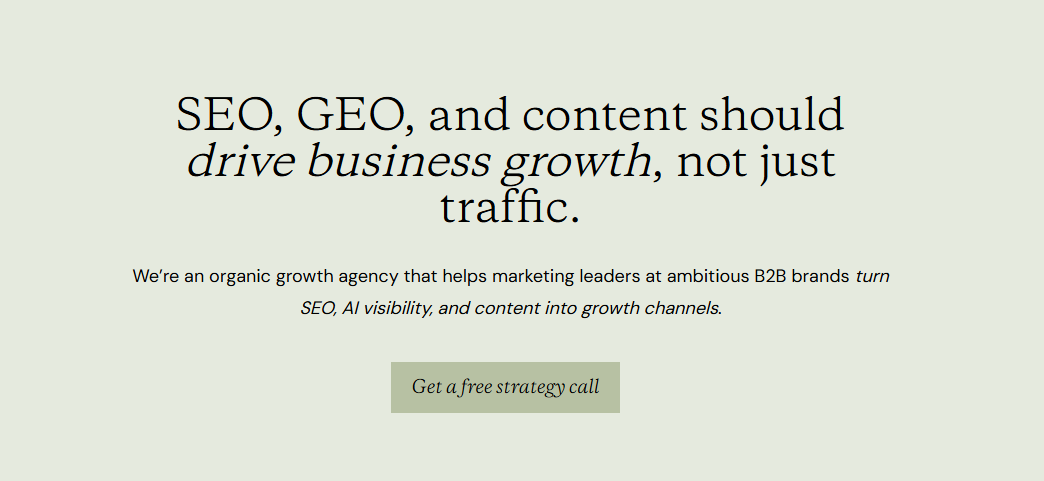
Omniscient Digital helps B2B SaaS businesses grow by improving their online content. Founded by former senior marketers from HubSpot, Shopify, and Workato, their client-centric approach involves understanding conversion goals, building a tailored SEO strategy, implementing the plan, and making improvements based on data.
Their consultative approach makes them popular across established companies. They follow what they call the Barbell Content Strategy: 90% product-led content that explains the product value proposition, and 10% buzzworthy content that attracts backlinks, attention, and social shares. Together both types combine to build topical and domain authority.
The founding team matters here. Alex Birkett led experimentation at Workato and growth marketing at HubSpot. David Ly Khim was Head of Growth at People.ai and a growth product manager at HubSpot. Allie ran content at Shopify. That in-house background shows in how they plan content around product marketing and voice-of-customer research instead of keyword lists alone.
They have also invested meaningfully in GEO, their generative engine optimization offering. It is listed as a dedicated service rather than a marketing rebrand, which is a good sign. They partner with Peec AI on AI-driven content optimization, and the service menu goes well past content: programmatic SEO, technical SEO, digital PR, and analytics are all in-house.
One thing I noticed: Alex Birkett recently shared that 189 of their own leads said they found Omniscient through ChatGPT, Claude, Gemini, Perplexity, or another AI engine. First-touch attribution captured only 28 of them. That's the attribution gap most agencies aren't even looking at yet, and it tells me they are measuring AI search the right way.
Client quote: “We’ve published over 100 articles which has also directly led to new business. We’ve created over $4M in annual recurring revenue through our blog.” – Austin Distel, Jasper
Key services: SEO strategy, content creation and optimization, link building, technical SEO, GEO
Notable clients: Hotjar, Jasper, Asana
Pricing: Full-service from $10,000/mo. Strategy from $15,000.
4. Optimist
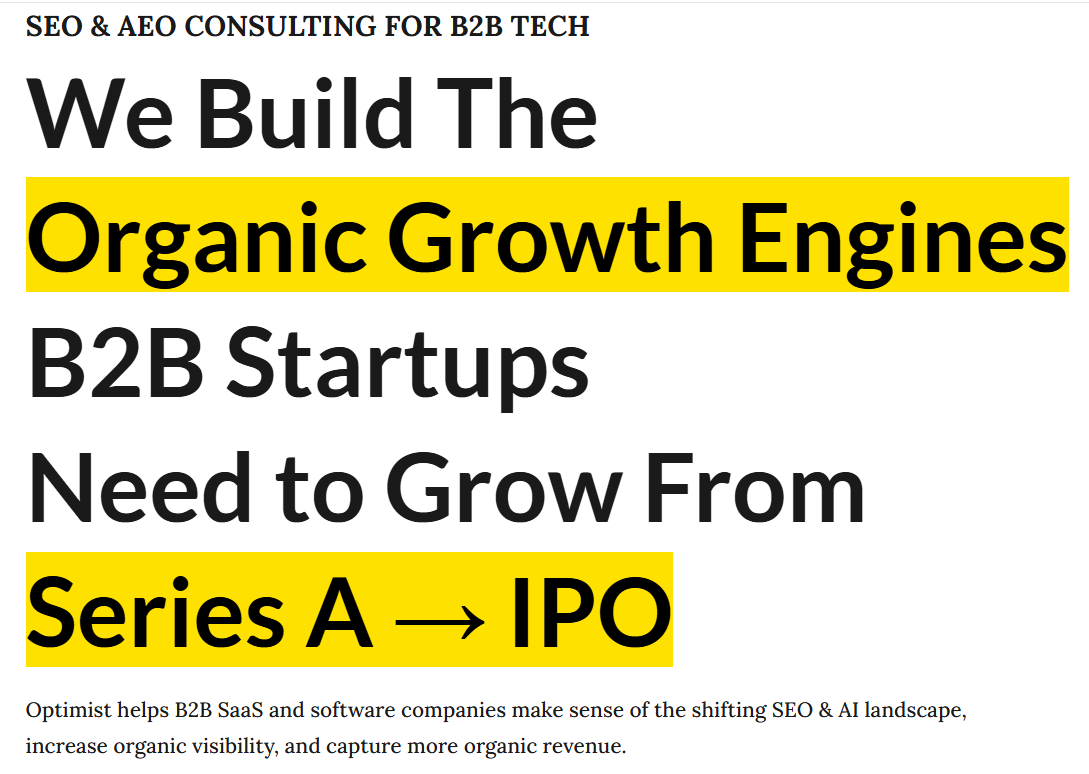
Optimist is one of the strongest AEO practitioners in the B2B SEO space right now.
They have published actual case studies showing revenue from AI search. Not just brand mention increases or AI visibility improvements, but dollars in the pipeline from ChatGPT, Perplexity, and Claude referrals. That is rare, and it matters.
The numbers are big. One B2B tech client saw 49x growth in LLM referral revenue, with LLM referral traffic up 2,622% over 14 months. A fintech client grew LLM referral traffic 25x in eight months. A retail tech client saw a 13x increase in LLM-sourced revenue year over year.
Their CORE framework (short for Complete Organic Revenue Engine) integrates AEO and traditional SEO from the start, rather than treating them as separate programs. It maps SEO and AEO goals to every stage of the buyer journey, then ranks the work by estimated revenue impact.
I also like where Tyler Hakes says to start. In his view, the first AEO move usually isn't schema or content structure. It's fixing the fact that your homepage, G2 profile, and LinkedIn page all describe your company differently. That's the right instinct. AI can't recommend you if it can't agree on what you do.
They also cover the full funnel: acquisition, activation, retention, revenue, and referral, which makes them unusual among content-first agencies. Unlike other agencies on this list, they do not just focus on demand generation. They are content experts across all SaaS funnel stages.
Client quote: “Working with Optimist is fantastic. They collaborate seamlessly with our in-house SEO team and maintain the high quality we aim for.” – Ana Camarena, Semrush
Key services: AEO and SEO strategy, content production, digital PR, link building, analytics
Notable clients: Semrush, Superhuman, ZoomInfo, HelloSign
Pricing: From $2,500/mo for entry plans. Full-service from $10,000/mo.
5. Directive Consulting
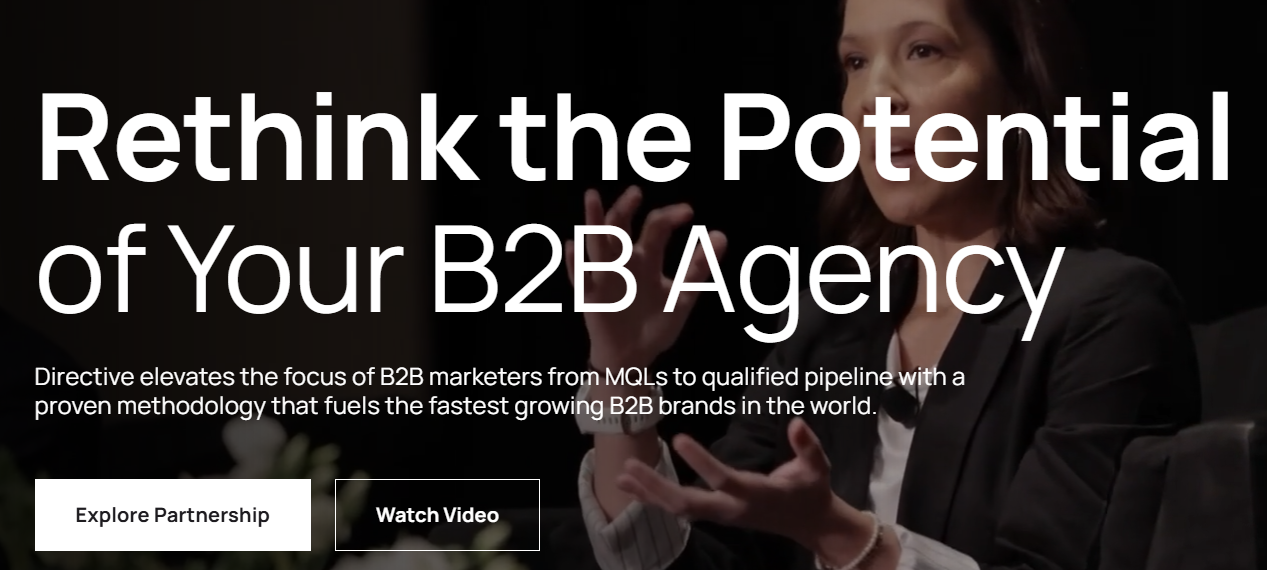
Directive is one of the larger performance marketing agencies built specifically for technology companies. They approach SEO as a revenue channel, not a traffic channel, which puts them ahead of most agencies their size.
Their Customer Generation methodology starts with your ICP, unit economics, and funnel strategy before it touches keywords. Every channel gets held to pipeline and LTV:CAC outcomes, not MQL volume. That's a finance-friendly way to run marketing, and it's why they tend to land with CMOs who answer to a board.
They have built GEO into their service offering and invest heavily in research and development, which means their approach tends to stay current as the search landscape shifts. Their GEO work blends technical SEO, content intelligence, and digital PR, and they run execution through their own AI platform, Stratos.
The scale is real. Directive reports 200+ employees, 420+ brands served, and more than $1B in revenue generated for clients.
Their pricing reflects their scale. They are a better fit for enterprise and well-funded mid-market companies than for growth-stage SaaS. But for the right company, the integrated SEO, paid media, and RevOps offering is genuinely difficult to replicate elsewhere.
Key services: SEO, GEO, content marketing, paid media, CRO, RevOps, video
Notable clients: Cisco, ZoomInfo, Gong, Uber Freight, Samsung
Pricing: Custom. Enterprise engagements typically from $20,000/mo.
6. Skale
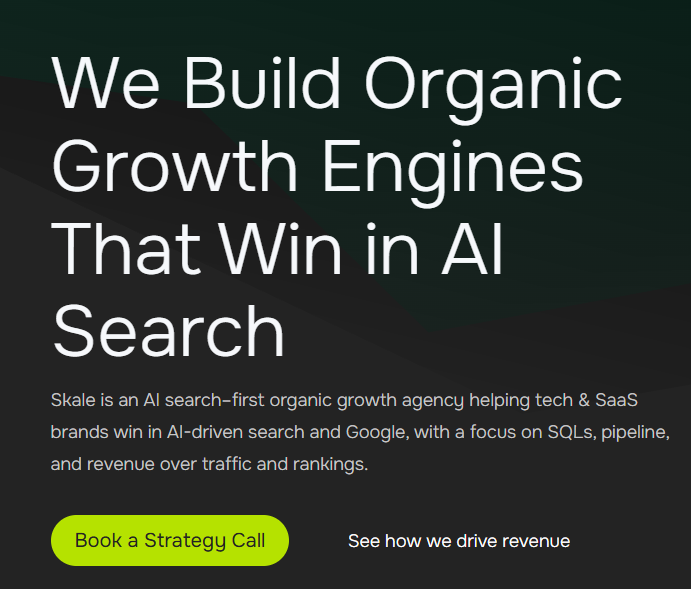
Skale helps B2B software businesses grow by improving their presence on search engines. They have helped many companies achieve significant results: Rezi increased revenue by 176%, Holded saw a 450% jump in monthly signups, and Flodesk boosted free trial signups by over 2,000%.
Co-founder Jake Stainer ran growth in-house as Head of Growth at Typeform before starting Skale with Italo Viale. You can see that operator background in how they report. Organic gets measured in signups, pipeline, and MRR, and their reporting plugs into your CRM so you can see it.
Their delivery model is pod-based. Each client gets a four-person team covering strategy, content SEO, technical SEO, and off-page. That structure lets them produce a lot of work without everything bottlenecking on one strategist.
Their approach balances short-term wins and long-term goals. Around 20% of growth comes from faster, easier wins that hit monthly targets while building for the future. The majority comes from harder, more valuable keywords that take more time.
GEO is listed as a service, though it appears to be an integrated add-on rather than a core part of their methodology. It covers entity building, structured data, and AI citation outreach, and they also sell AI citations as a standalone service for teams with a narrower need.
Notable clients: Rezi, Moonpay, PicToChart
Pricing: Full-service from $4,000/mo
7. MADX Digital
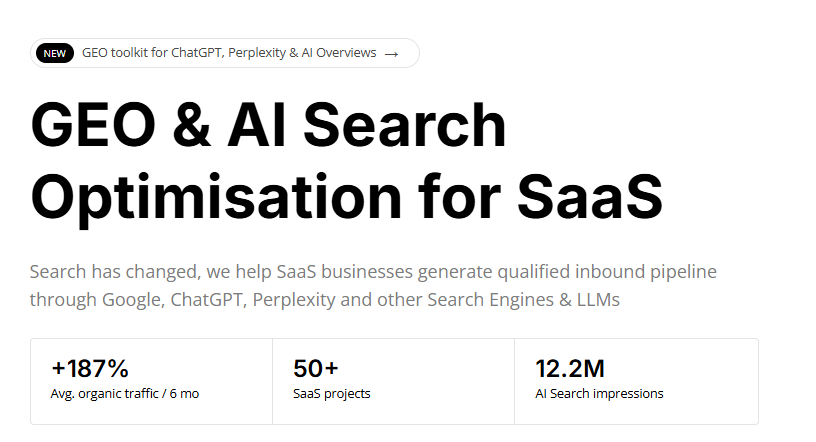
MADX Digital is a revenue-first B2B SaaS SEO agency that delivers custom services spanning technical SEO, content writing, digital PR, link building, and Generative Engine Optimization for AI search platforms, including ChatGPT, Perplexity, and Google AI Overviews.
Their framework operates in seven structured steps: technical SEO audits, keyword and audience research, on-page optimization, content strategy, authority building, performance tracking, and iteration. They have dedicated service tiers for Seed, Series A, and Enterprise clients, which means they can serve companies at different stages without one-size-fits-all pricing.
They were earlier than most to formalize a GEO offering, with their own AI search tracking and brand mention campaigns designed to get clients cited. Their Postalytics case study shows what that looks like when it works: organic traffic grew 16.8x in 12 months, from 4,916 to 82,505 monthly visits, and Postalytics now holds a 90% AI share of voice across its industry prompts in ChatGPT, Perplexity, Gemini, and AI Overviews.
Other results are well-documented too. Parcel Tracker grew from 1,000 to 45,000 monthly organic visitors under their management, and their MoonPay work produced more than 3,000 page one rankings while supporting expansion into new markets.
The part that stands out most is the guarantee. If you are not in Google's top 5 for three agreed keywords within 90 days, they refund the project fee and you keep the content and links. Very few agencies put their money where their mouth is like that.
Notable clients: MoonPay, Postalytics, Parcel Tracker, Veed.io, TitanHQ
Pricing: Available on request. Tiered by growth stage.
8. Siege Media
Siege Media specializes in content-driven SEO for B2B brands, combining high-quality content production with data-backed SEO strategies to drive measurable organic growth. Their strength is producing large, research-backed content assets that earn backlinks naturally, which compounds domain authority over time rather than relying purely on outreach-based link building.
In competitive B2B markets, that kind of authority building can move rankings in a way that individual link inserts cannot. They are not a heavy technical SEO shop. Their value is in editorial quality and content strategy.
They've built real tooling around that process. BlueprintIQ analyzes your site against competitors to build a roadmap of 300 to 400 topics, and DataFlywheel refreshes existing content at a pace of 20 to 60 pages per quarter. They also run dedicated GEO practices across eight industries, including SaaS, fintech, and cybersecurity.
Ross Hudgens is one of the more credible voices on AI search right now. His book, Generative Engine Optimization: The Definitive Guide to AI SEO, is coming out with Wiley. And Siege has made the Inc. 5000 six years in a row, so this is a stable, proven shop.
For B2B companies that have strong product stories but need help turning them into content that earns real organic authority, Siege is worth considering.
Notable clients: Zillow, Intuit, HubSpot
Pricing: Available on request
9. Virayo
Virayo has built a reputation for data-driven B2B SaaS SEO tied to pipeline and ARR rather than traffic. They are also ahead of many agencies their size on AI search adaptation, with their lead strategist regularly publishing content on LLM visibility and how SaaS companies should adjust their strategies.
Their content starts at the bottom of the funnel: product and feature pages, competitor comparisons, and pain-point content. Those are the pages high-intent buyers read, and they're also the pages LLMs lean on when they answer "what's the best tool for X?"
Where they really stand out is measurement. The Virayo AI platform tracks how ChatGPT, Claude, Perplexity, and Gemini cite your brand, including visibility, sentiment, referral traffic, and conversions from each LLM. It also flags when AI gets your features, integrations, or pricing wrong, which is a bigger problem than most teams realize. Bad AI answers send you poor-fit trials while your best-fit buyers go to a competitor.
Off-page, they work to get clients mentioned in the sources AI engines reference most: industry publications, review sites, directories, and listicles. They offer technical SEO alongside content and strategy, plus paid search if you want it under the same roof.
Key services: SEO strategy, technical SEO, content strategy, AI search visibility
Notable clients: Sprout Social, MYOB, Brandfolder, Truckstop
Pricing: Available on request
10. Quoleady
Quoleady helps B2B SaaS companies grow their visibility across both traditional search engines and AI-driven platforms. Their AEO offering includes LLM visibility audits, schema markup, llms.txt setup, and digital PR placements designed to get brands into high-trust publications that AI systems pull from.
They published a case study with Legal Nodes showing a 47.5% increase in booked meetings from AEO work, along with top-five AEO rankings within three months. That is one of the more concrete outcome metrics I have seen from an agency in this space.
Their off-page game is stronger than the price suggests. They've landed clients like airfocus in Forbes, Crunchbase, and TechCrunch, and they sell brand mention and listicle placements as part of the program. One client, Expandi, credits them with helping grow from 0 to $8M ARR.
They tend to work with mid-size B2B SaaS companies and have strong experience with European markets.
Key services: SEO strategy, content marketing, AEO and LLM visibility, link building, digital PR, technical SEO
Notable clients: Expandi, PandaDoc, monday.com, airfocus
Pricing: Retainers from $1,500 to $2,000/month
How B2B SEO Has Changed
SaaS SEO in 2016 and B2B SEO in 2026 are two different games.
When I started in 2015, all I needed to do was:
- Keyword research – find high traffic, low competition keywords.
- Content brief – create an outline for the writer.
- Hire a cheap writer – pay someone who has no idea what they're talking about 10 cents a word.
- Scale up – repeat.
But today, buyers are more sophisticated and they know when they are reading generic content.
AI Overviews are consuming the top of the SERP.
Clicks to the number one position are down significantly where AI answers appear.
And buyers are increasingly starting their research in ChatGPT and Perplexity, not Google at all.
The companies winning at B2B SEO in 2026 are doing three things the old playbook never required:
- Creating content with a real point of view, built from interviews with subject matter experts and sales teams, not from reading competitor posts.
- Building brand presence off-page through podcasts, YouTube, guest posts, listicles, and brand mentions that tell AI systems who they are and what they solve.
- Measuring revenue, not vanity metrics. If organic is not driving trials, demos, and MRR, the strategy is not working, regardless of what the traffic chart looks like.
| Before | Today |
|---|---|
| Keyword research, outsource to cheap writer | Interviews with SMEs, content with a unique POV |
| Top, middle, and bottom of funnel content | Heavy emphasis on bottom of funnel first |
| Build links to rank | Build links, listicles, and brand mentions to rank AND get recommended |
| Create as much content as possible | Create only the pages you need to generate revenue, then spend the rest of your time and money off-page |
| Give a nod to the Google Gods | Cross-platform visibility |
| Capture existing demand | Create demand |
4 Factors to Look for When Hiring a B2B SEO Agency
Factor 1: Buyers are more sophisticated
There was a stretch of time, and maybe we are still in it, where buyers knew that the page one results were simply SEO content designed to rank.
The type of homogenized content outsourced to a writer with no domain knowledge.
This turned off the most sophisticated buyers. The ones most likely to actually buy your product.
The best agencies today create content that ONLY your company can create. Content that reflects a real point of view, real customer language, and real product knowledge.
Factor 2: Be recommended, not just ranked
We are moving into an era where if your SaaS is not recommended by LLMs, it is going to be hard to compete. And no, AEO is not just SEO done well. It is part of it, but not all of it.
Your agency needs a strategy to get your SaaS on the shortlist of tools that LLMs recommend. This is done through the way content is created, the way link building is done, and how the brand is built off-page.
Factor 3: Create demand
SEO used to be about fulfilling demand. Someone searched for your product, and you just needed to appear. But space in the SERPs is becoming more limited. And even if you hit position one, you are not getting the same click-through rate as you once did.
As an SEO agency, we are now responsible for creating demand, not just capturing it. By getting you in front of more audiences through podcasts, YouTube, guest posts, and brand mentions, so they can discover and share your product.
Factor 4: Revenue is the only metric that matters
For the longest time, SEO agencies used traffic as their key metric. But now agencies are under scrutiny from finance teams and boards. You need to justify the cost.
Is revenue going up? If yes, your SEO is working. If not, it is not. Everything else is noise.
| Before | Today |
|---|---|
| Analyze the SERP | Create content with a unique POV |
| Create content that ranks based on the SERP | Build a brand, not just a backlink profile |
| Top, middle, and bottom of funnel content | Focus mostly on bottom of funnel content |
| Build links | Get your SaaS shortlisted by LLMs |
| Give a nod to the Google Gods | Cross-platform visibility |
| Capture existing demand | Create demand |
How to Choose the Right B2B SEO Agency
Now that you have read through these agencies, here are the questions to ask yourself when making a decision:
- What is my SEO budget?
- Does the agency have a genuine AEO strategy? How will they help you get recommended in LLMs?
- What approach will work best with my existing marketing team and current SEO efforts?
- How soon do I need to start seeing results?
- Do they measure success in revenue, or in traffic and rankings?
We do this for B2B SaaS companies every day.
Book a free strategy call. We will look at your category, identify high-leverage opportunities, and show you what a content program built around your revenue goals would look like.
Book Your Free Strategy Call