When companies come to us and say that they have traffic, but no revenue, I can always point to one thing:
Their keyword research strategy is off.
So many SEO teams and agencies target keywords with high search volume and low difficulty scores.
These keywords are easy to rank, traffic goes up, and everyone wins, right?
Unless you’re a SaaS company looking to increase MRR and not traffic.
We’re going to cover how to create a keyword research strategy that helps you attract high intent traffic to your site and convert that traffic into qualified trials and customers.
What We Are Actually Trying to Do
I started my SEO career at a bootstrapped SaaS company back in 2015.
We didn’t have any runway. We had no VC umbrella. And we didn’t have a budget. This turned out to be a blessing in disguise.
We didn’t have the time or money to spend on content that didn’t convert. We didn’t have the budget to build links on articles that weren’t going to drive MRR.
That meant we weren’t writing top of funnel “what is” posts. And we didn’t spend time creating a glossary of terms.
We spent 100% of our time writing “Alternatives” posts and creating “how to” tutorials that featured our product.
That led to our higher converting pages converting 2% of traffic into paying customers.
Eventually, we got the site up to 400,000 visitors a month in organic traffic alone.
Here’s my challenge to you: every keyword decision you make should run through one simple question: Are the people searching for this capable of becoming customers?
Step 1: Talk to Your Customers Before You Open a Keyword Tool
Your customers will be able to inform you what kind of keywords you should be targeting and what needs to go into your content.
The three questions from Time Doctor:
- What tools do you and your team use right now?
- What was the last software you purchased, and what are you using it for?
- What tool are you using now but looking to replace, and why?
- When you were looking for a tool like ours, what did you search for?
- Which competitors did you evaluate before choosing us?
- What would you search for in Google if you were trying to solve [the problem your product solves] today?
- What do you wish existed that does not
These conversations surface real category language.
For instance, a customer might say something like “We’re using Toggl, but we’re looking to switch to something else. Here’s the three features that we’re looking for, and it needs to integrate with these 5 tools.”
Now we know that we should look into creating a post around Toggl Alternatives and we know that when we create the content, our comparison should list the features and integrations most important to the customer.
(Note: This is a simple example. When you do this, you’re going to have hundreds of data points. Look at the patterns that your customers tell you and let that inform your content and keyword decisions)
Step 2: Forget Top of Funnel. Focus on Buyers.
Every keyword worth pursuing has one thing in common: the person searching is already trying to solve the problem your product solves, or they are already evaluating tools in your category.
"What is project management" is not a keyword that produces trials. The person searching it is not close to buying anything.
We do not write that content. Not because it cannot work, but because there is no reliable way to connect an informational searcher to a buyer decision without a lot of time, a lot of content, and a lot of faith.
That narrows the keyword universe considerably. That is the point.
Step 3: Match Your Keyword to a Content Archetype
Finding the right keyword is half the job. The other half is knowing what to build around it.
Five archetypes consistently outperform everything else. Every one of them maps directly to buyer intent.
Alternative Post
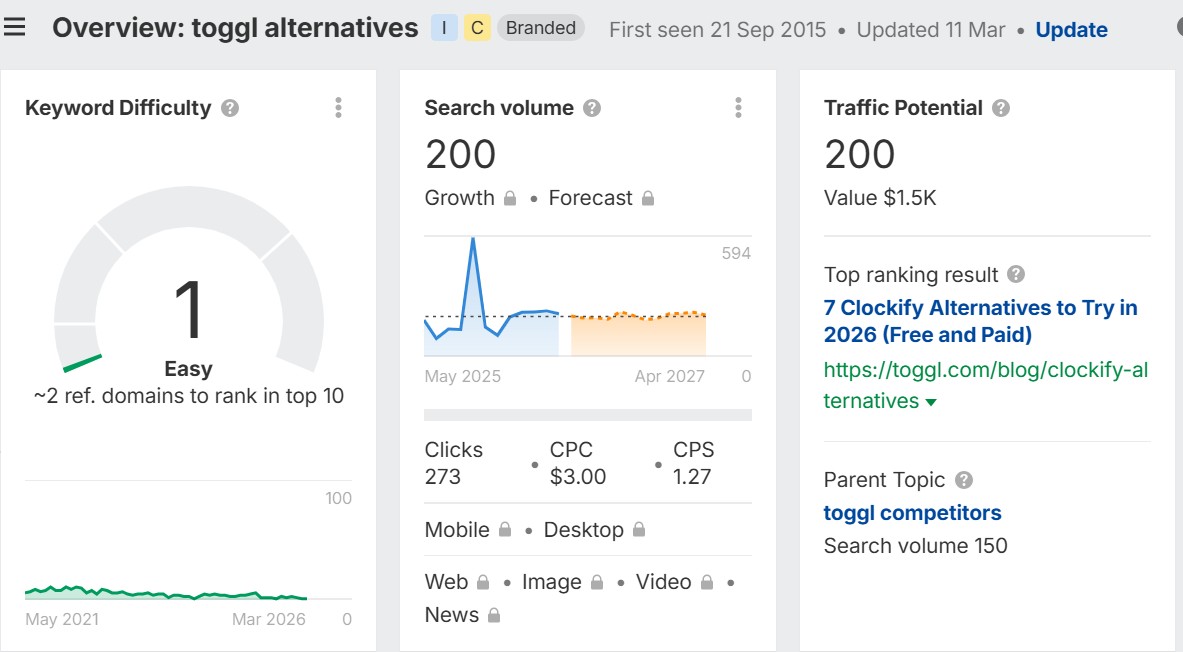
"Toggl alternatives" captures buyers who are unhappy with a competitor and actively shopping. The most commercially qualified traffic you can get. At Time Doctor, every alternatives post we wrote added roughly two paying users per month.
The alternative post is built around one keyword structure: "[Competitor name] alternatives."
The keyword research process for this archetype is different from every other type because you are not looking for search volume on your own brand. You are looking for search volume on your competitors.
How to find them:
Go into Ahrefs and make a list of every competitor in your category. Then plug "[competitor name] alternatives" into the keyword explorer for each one. You are looking for:
- Competitors with meaningful search volume on their alternatives keyword
- Keywords where the SERP is blogs and listicles, not G2 and Capterra dominating every spot
- Competitors your customers actually mentioned when you talked to them in Step 1
That last filter matters. If a competitor's name never came up in your customer conversations, their alternatives keyword probably does not attract your buyers.
What good looks like:
At Time Doctor, Toggl was the name that kept coming up in customer conversations.
When we checked "Toggl alternatives" in our keyword tool, the volume was modest but the SERP was beatable.
More importantly, every single person landing on that post was already unhappy with a competitor and actively shopping. That is the highest-quality buyer traffic you can get from organic search.
Low volume on an alternatives keyword is not automatically disqualifying. Two paying customers per month from a 200-search keyword compounds fast.
A note on SERP composition here specifically:
The alternatives SERP is often dominated by G2, Capterra, and Trustradius.
If those sites own the top five positions, you need to assess honestly whether a blog post can break in. Sometimes the answer is yes with enough links.
Sometimes you are better off targeting a slightly less competitive competitor's alternatives keyword first, ranking, building authority, and working up.
X vs Y Post
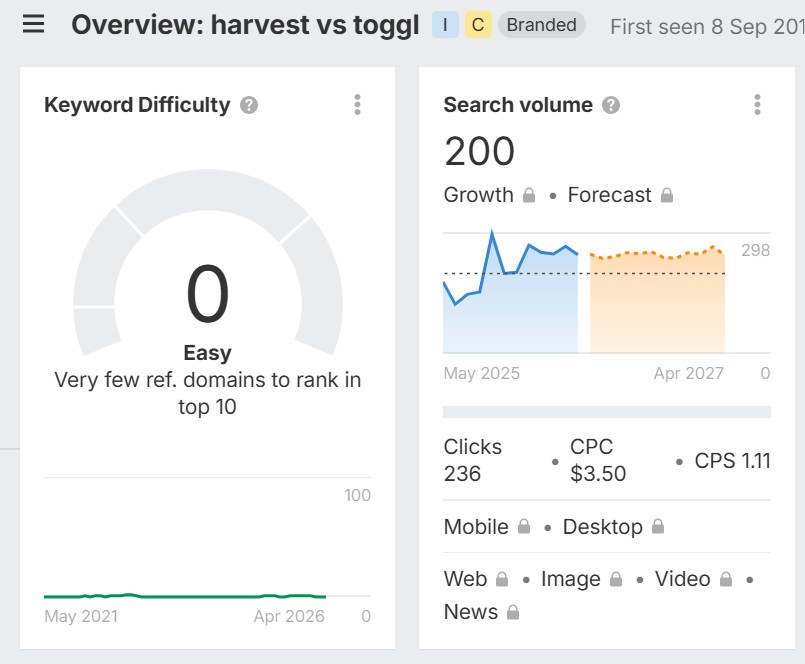
"Harvest vs Toggl" captures buyers deep in evaluation comparing two known options. These are people who have already narrowed their shortlist and are looking for something to make the final decision for them.
Conversion rates on comparison posts are exceptionally high because the intent is so specific.
The keyword research process here has two paths depending on where your brand is today.
Path 1: Your brand is big enough to anchor one side.
Plug "[your product] vs [competitor]" into Ahrefs for every competitor your customers mentioned in Step 1. You are looking for:
- Comparisons where your product name has enough brand recognition to generate search volume
- Keywords where the SERP is company blogs and review sites you can compete with
- Competitor names that come up repeatedly in your sales conversations as the thing prospects are switching from
Path 2: Your brand is not big enough yet.
This is the Trojan Horse approach. Instead of anchoring the comparison yourself, you write "[Competitor A] vs [Competitor B]" and introduce your product as the better third option inside the article.
Go into Ahrefs and search for comparison keywords between the two or three biggest names in your category. You are looking for:
- High-authority competitors whose brand names generate comparison search volume
- SERPs where blogs and company articles are ranking, not just review sites
- Comparison pairs that reflect the decision your buyers are actually making
At Time Doctor, before we had the brand authority to anchor our own comparisons, we wrote "Harvest vs Toggl."
Those were the two names everyone in our market knew.
We compared them honestly, then introduced Time Doctor at the end. We got the search traffic from the comparison and introduced our product to a buying audience at exactly the right moment.
A note on SERP composition:
Comparison SERPs tend to be more winnable than alternatives SERPs because review sites are slightly less dominant.
You will still see G2 and Capterra but you will also see more company blogs in the mix. That creates real opportunity, especially with a targeted link building push to the page.
Best Category Post
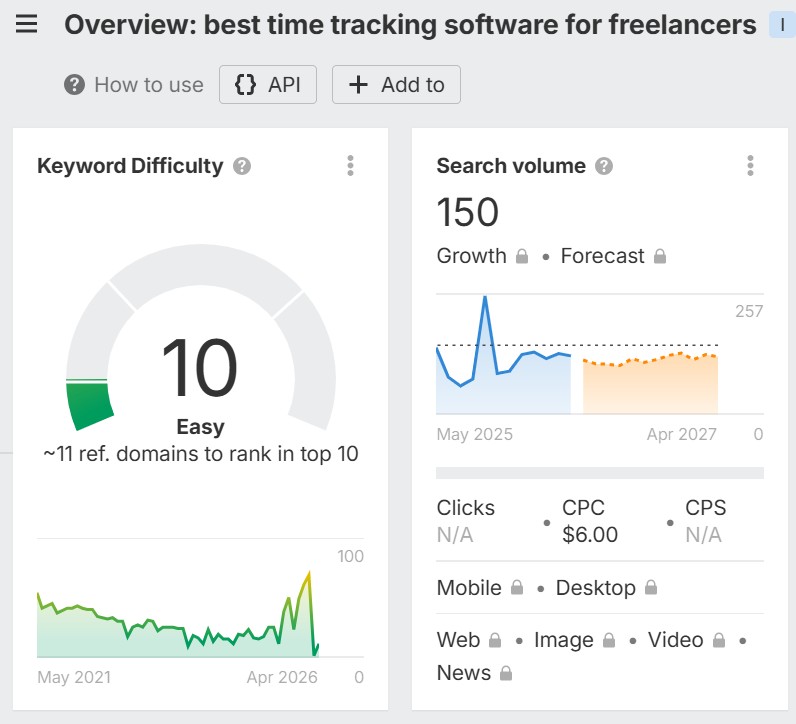
"Best time tracking software for freelancers" captures buyers who know they have a problem and are actively looking for a shortlist.
This is the format that also gets pulled most heavily by AI when someone asks for a product recommendation. One piece of content, two channels.
The keyword research process for this archetype is about finding every category your product belongs in, not just the obvious one.
How to find them:
Start with your core category keyword: "best [your product category]." Plug it into Ahrefs and note the volume and SERP composition.
Then expand outward by asking: what types of customers use our product, and what category would they search for?
At Time Doctor, the obvious category was "best time tracking software." But we also belonged in:
- Best HR tools for agencies
- Best project management tools for remote teams
- Best employee monitoring software
- Best tools for managing remote employees
Each of those is a separate keyword with a separate SERP and a separate buyer audience. The product is the same. The content angle changes slightly to match the category.
You are looking for:
- Category keywords with meaningful volume where your product genuinely belongs
- SERPs where blogs and listicles are ranking, not just G2 and Forbes dominating every position
- Categories that reflect actual use cases your customers mentioned in Step 1
What good looks like:
The best category post is the archetype with the highest ceiling for AI recommendation value.
When someone asks ChatGPT "what is the best time tracking software for remote teams," the AI is pulling from exactly this type of content.
A well built best category post does not just rank on Google. It trains AI on which category your product belongs in and who it is for.
A note on SERP composition:
Best category SERPs are often the most competitive because review sites, Forbes, and G2 tend to rank well here.
Look carefully at positions four through ten. If there are company blogs or smaller agency sites ranking in that range, you have a path in.
If the entire top ten is Forbes, G2, Capterra, and Trustradius, this keyword needs serious link equity before it is worth targeting.
Template Post
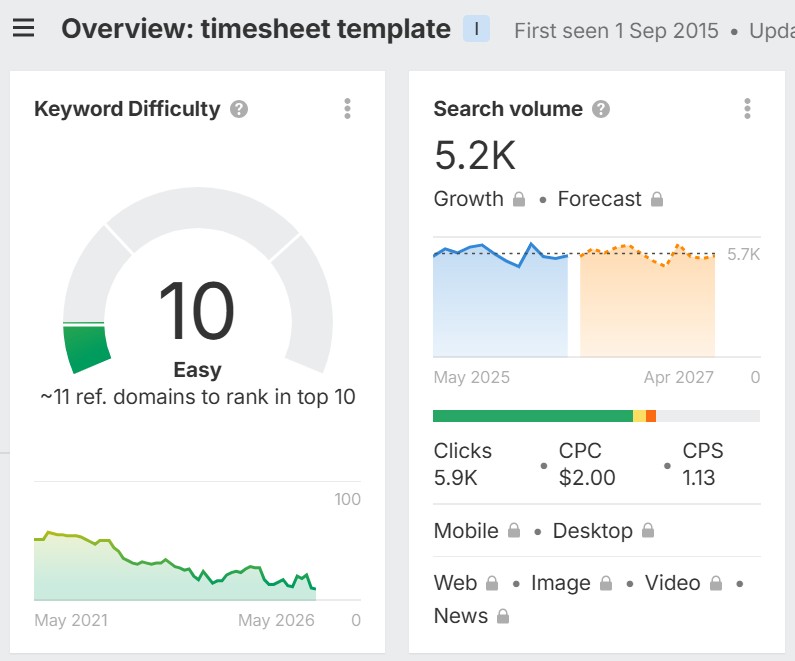
"Timesheet template" captures buyers who are solving your product's problem manually.
They are not yet in evaluation mode but they are doing the exact job your software does, by hand. Most will take the free template.
A meaningful percentage will convert when they realize the software does it better.
The keyword research process for this archetype starts with a different question than the others. Instead of asking who is evaluating tools, you are asking: what is someone doing manually that our product automates?
How to find them:
Make a list of every manual process your product replaces or improves. Then search "[that process] template" in Ahrefs. You are looking for:
- Template keywords with real search volume tied to your product's core use case
- SERPs where the top results are free resource pages and blog posts, not software landing pages
- Keywords where the manual version of the job is something your buyers actually do today
At Time Doctor, our product tracked time automatically.
The manual version was a timesheet. "Timesheet template" had strong volume and a beatable SERP. We gave the template away completely free, no email gate, and let the content convert people who realized they did not want to manage timesheets manually.
What good looks like:
The conversion mechanism is different from every other archetype. You are not pitching your product directly. You are letting the manual process sell the software for you. By the time someone has downloaded the template and tried to use it, the case for your product makes itself.
A note on SERP composition:
Template SERPs tend to be very winnable because they are not dominated by review sites. You will typically see a mix of blog posts, free resource pages, and occasionally a SaaS company that had the same idea you are having now.
If a competitor already has a template post ranking well, that confirms the keyword works. It does not mean you cannot outrank them with a better resource.
Jobs to be Done Post
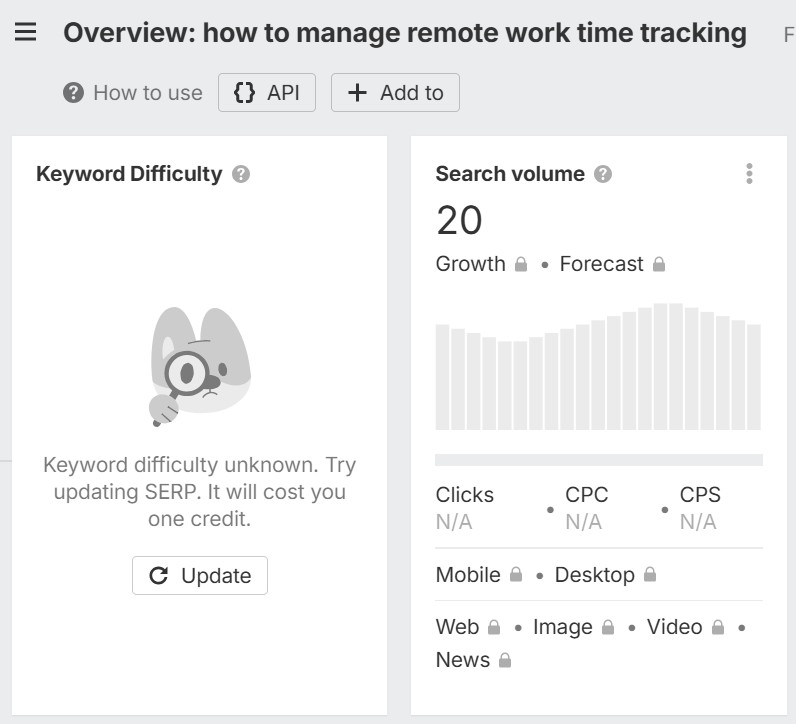
"How to manage remote work time tracking" captures buyers who are searching for a solution to the specific job your software performs.
They are not yet evaluating tools. They are trying to figure out how to do something, and your product does it better than the manual approach they are about to learn.
The keyword research process here starts with your product's use cases, not its category.
How to find them:
Go back to your customer conversations from Step 1. For every use case that came up, build a "how to" keyword around it and plug it into Ahrefs. You are looking for:
- How-to keywords directly tied to the job your product performs
- Meaningful search volume with a SERP of blog posts and tutorials, not product pages
- Use cases that multiple customers mentioned, which signals real search demand
At Time Doctor, customers used the product for things like tracking remote employee hours, estimating project costs, and managing agency billing.
Each of those use cases became a jobs to be done keyword: "how to track remote employee hours," "how to estimate project time," "how to bill clients for time."
You are not guessing at these. Your customers told you in Step 1 exactly what jobs they hired your product to do.
What good looks like:
The jobs to be done post is the archetype where your product earns the right to be recommended by doing the teaching.
You walk the reader through how to solve the problem step by step, using your product to do it. By the end, they have learned something genuinely useful and seen your product in action. That combination converts.
A note on SERP composition:
Jobs to be done SERPs are typically the most winnable of all five archetypes because they attract fewer big-domain competitors.
Review sites do not rank for "how to track remote employee hours."
Blog posts and tutorials do.
If your content is genuinely more useful and more specific than what is currently ranking, you have a real path to page one without needing exceptional domain authority to get there.
Step 4: Evaluate Keywords
When we do our keyword research, we look at three things.
Buyer Intent:
When evaluating buyer intent, we assess the likelihood that a reader will purchase after consuming the content. We score content on a scale of 1–3:
Score 1 – Top of Funnel: The post is unlikely to convert. It targets early-stage readers who are just becoming aware of a problem or solution.
Score 2 – Middle of Funnel: The reader has some intent but still requires nurturing before converting.
Score 3 – High Buyer Intent: The post is highly likely to drive conversions. These readers are close to making a purchase decision.
When targeting keywords, we prioritize Score 3 content first, then work our way down to Score 2, and finally Score 1.
Search Volume:
When it comes to search volume, we don’t care that a keyword doesn’t have many searches - as long as it has some searches.
So even if there’s 10 searches per month, we’ll still create content for that page. Especially if there’s a high buyer intent.
A few reasons why:
- We want to talk to those ten people who are searching.
- Usually these pages rank for other keywords. So traffic can get into the hundreds of visitors a month.
- These pages usually don't have much competition, so there’s not going to be a huge need for expensive link building.
Search Intent:
And finally, we want to ensure the content that we create matches the search intent.
Does the keyword need a list post or a how to post or a service page in order to rank?
You can look at the SERP and get a good idea of the type of content already ranking.
Step 5: Prioritize the Keywords You Can Win
Let’s face it.
Most SaaS companies are in very competitive markets. For instance, if you’re selling Email Marketing Software, then you know that Email Marketing is a huge keyword that you’re probably not going to rank for.
As you can see in the picture below, “email marketing” is a high-competition keyword with some tough stats:
- Search volume: 105,000 searches/month
- Keyword difficulty: 78 out of 100
- Referring domains needed to rank in the top 10: ~310
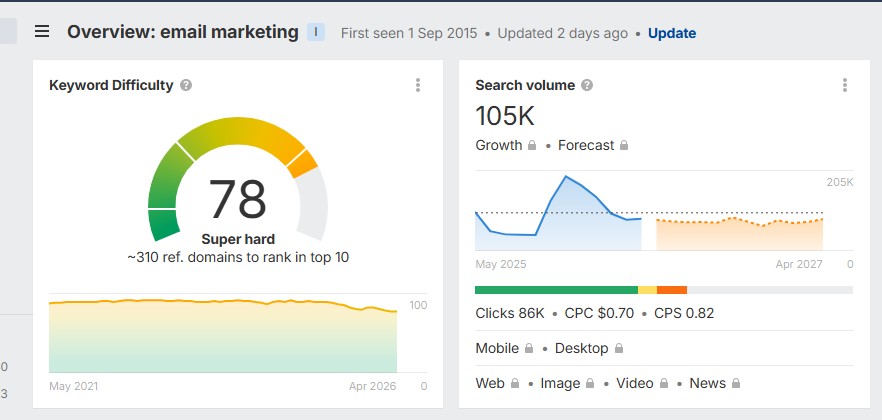
That’s quite a bit. Instead of targeting these high-difficulty keywords from the start, we recommend going after keywords you can actually win.
In Ahrefs (and SEMRush), you can go to the keyword explorer and type in “your industry for”.
So in the case of Email Marketing, you can enter “Email marketing for” and it’ll give you a list of keywords with that phrase.
Now, you can find keywords around your ICP that are much easier to rank.
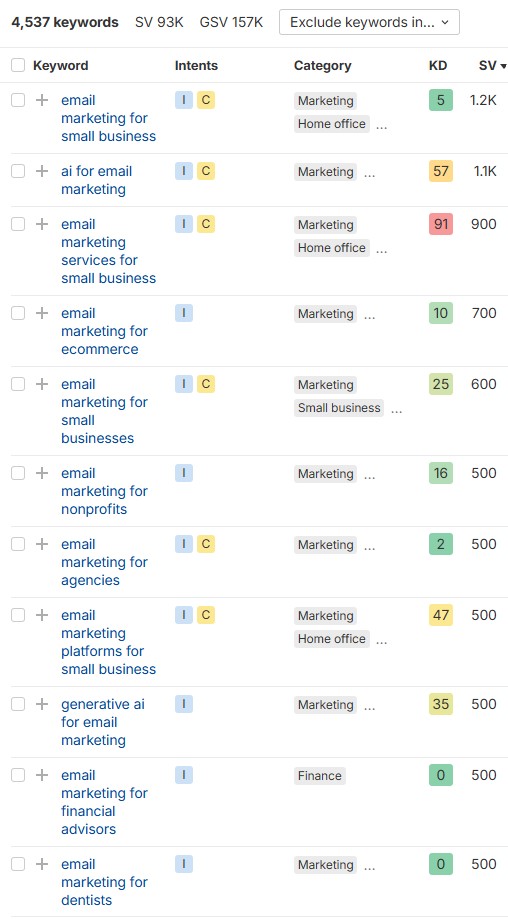
For instance, Email marketing for financial advisors has a keyword difficulty of 0. Email marketing for dentists is also 0.
These are keywords you can rank for within a few weeks of publishing.
What to Do With Your Keyword List
Start with 10 to 15 keywords that you’ve given a score of 3 to. Prioritize the ones with beatable SERPs and clear buyer intent. Build the archetype that matches the keyword. Measure trials per post, not traffic per post.
Then build links to the posts that matter. Rankings without links stay on page two. The keyword research tells you what to build. The link building determines whether it ranks.
Revenue Is the Only Filter That Matters
Every keyword decision runs through one question: does ranking for this bring us closer to MRR? If the answer is not obvious, the keyword is probably wrong.
Keyword research feeds content quality, which feeds link building, which feeds AI recommendations. All of it connects. This post is one piece of that.
We do this for B2B SaaS companies every day.
Book a free strategy call. We will look at your category, identify high-leverage opportunities, and show you what a content program built around your revenue goals would look like.
Book Your Free Strategy Call